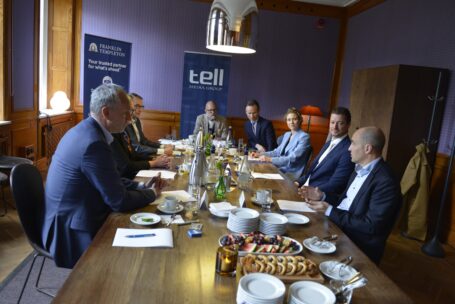
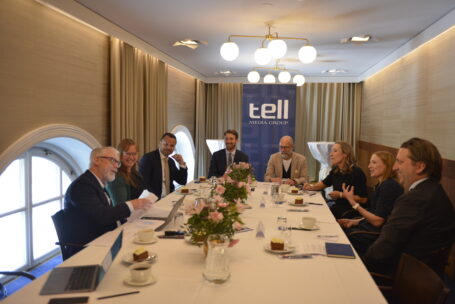
The roundtable kicked off with the investors at the table sharing what expectations they had going into 2025 and what they have seen as the biggest surprises over the year when it comes to investments and markets.
Per Lindgren: “Entering this year, I felt that the market was underestimating how ruthless Trump would be when he would start his second term. I must however say that I was still surprised when he commenced all his efforts – starting a trade war against the rest of the world, alienating Europe and also trying to take control of the Federal Reserve. He not only pursued his political agenda, but he went a lot further than I think I expected and also further than the market in general expected.”
Marcus Svedberg: “I agree on that. On the one hand I’ve been surprised of how bad the policies have been, but on the other hand I’ve also been surprised how strong the AI investment boom has been. And, from a market perspective the tech boom has so far trumped the bad policies. What also surprised me was the very strong rally of the Swedish Krona in the first quarter.”
Michael Livijn: “I actually went back and had a look at what I wrote a year ago – and the short story is that I was a bit cautious – and the reason is that I tend to be a little bit suspicious when we’ve had strong years one after another and that’s what we’ve had since the fall of 2022. My return expectations were therefore a bit subdued, and then 2025 happened. What did surprise me was the adaptability of the global economy and global markets. We’ve been through a lot this year and still most assets are around or at all-time highs and I didn’t expect that.”
Maria Wendestam: “I was also surprised by the drastic moves that Trump has made, which far outweighs what we saw in his first term as president. He has clearly had more time to prepare, and we don’t see many established White House people – he has picked his own friends this time. I for one didn’t expect the liberation day to be that extreme and I’m also surprised that the US has still been quite resilient. I also remember that a year ago I still thought that Trump taking his hand away from Europe could be a good thing – making Europe come together.”
Niklas Tell: Mamdouh, from your point of view as a systematic investor, what would you say have worked and what has either surprisingly not worked or surprisingly worked?
Mamdouh Medhat: “We’re very data-led and we’re always very careful in terms of forming expectations or coming up with forecasts. We enter every year expecting an equity premium, because we have no evidence to suggest that we won’t get one. And we enter every year expecting certain sub-segments of either stocks or bonds to outperform others. Trying to predict exactly where and when that’s going to happen is of course extremely difficult. However, if you looked at the valuations of US companies, especially US large cap and US large cap growth companies at the beginning of 2025 and then looked at how they’ve performed throughout the year – I think that is a bit surprising. I think you probably would have expected them to lag other groups of stocks and other regions that had lower valuations. But then again, they’ve been so profitable that their relative prices have actually come down a little during the year. I think what we’ve seen is, despite all the geopolitical noise, tariffs and volatility, things have worked surprisingly well. It’s basically just markets pricing in whatever they can and things have worked.”
Maria Wendestam: “It must be easier for you, being very data-driven, to just disregard the noise?”
Mamdouh Medhat: “It’s never easy to invest, but at least we have a foundation that says if you zoom in too much and focus too much on the short term, if you try to over-engineer your thoughts around a particular policy or a particular decision, you kind of lose track of the forest from the trees. This is where having a bit more of a zoomed-out data lens can be helpful and complementary to many asset owners who combine a systematic approach with a discretionary one.”

Patrick Brenner: “We came into this year with a positive view on risk asset in general because we thought that the probability of a recession was pretty low and that has been correct. However, we were taken completely by surprise by Liberation Day but even more surprising was the reaction of the market. It’s difficult to believe how corporates have been able to integrate this in their business models and how consumers have been able to live with this uncertainty. I think this is really what has surprised me the most this year.”
Per Lindgren: “And it’s not only this year. If you go back, we had the Covid pandemic in 2020, Russia invading Ukraine in 2022 and Middle East tensions in 2023 and also this year and now we have the trade war. And maybe not only adaptable this year. I think six years ago, if we would have known that in 2020, we would have a COVID pandemic. 2022, Russia would invade Ukraine. 2023, we would have the Middle East tensions rising as well as this year. And then we’ll have the trade war this year. We’ve had a lot of geopolitical crises, and the financial markets have absorbed it and moved on to some extent.”
Niklas Tell: And why is that?
Patrick Brenner: I don’t know the why, but I think what’s interesting is the impact on inflation from these events. I think the expectations from the de-globalisation and trade war pushed by Trump would be much higher inflation, but we haven’t seen that – at least not so far.”
Mamdouh Medhat: “Coming back to your question why markets have behaved in the way they have – I think we almost need to ask why not. What gives you any kind of indication that markets are not going to be able to function? I think what we are witnessing is that the market is just so forward-looking. They look beyond what is happening right now and then they try and price in what’s going to happen in the future. And when I say they, I mean everybody who’s allocated to any asset class, who’s rebalancing out of an asset class, sometimes for information, sometimes for liquidity and sometimes for a combination of the two. We have 100 years of data on stocks in the US, and over those 100 years, on a log scale, growth of wealth is pretty much a straight line. With that in mind I don’t think it should be a surprise that markets have behaved the way they have despite all the things that have happened. That can sometimes seem inhumane, but I think it’s just all of us coming together and aggregating all our thoughts and disagreements into information that’s reflected in prices.”
Marcus Svedberg: “I agree with that, but… If you zoom out and look at the crises over the last five, ten or 15 years the answer is always the same. Whatever happens, central banks are going to provide liquidity and whatever happens, finance ministries are going to provide fiscal stimulus. Even the democrats in the US have given up on trying to balance the budget because it will not win you elections. Most countries are the same, maybe with the exception of Sweden and the Nordics, which are outliers in this respect. I agree that companies have been very good at working with their supply chains, finding new markets and navigating both geopolitics and tariffs – but at the end of the day it comes down to pumping in liquidity. However, at some point, someone will have to pay.”
Patrick Brenner: “The risk has clearly moved from private balance sheets to public balance sheets and I agree on liquidity, but it only works until it doesn’t. What will stop it from working is if the bond market stops behaving and I think bond markets increasingly focused on this.”
Per Lindgren: “I think it’s worth remembering James Carville, who was a political advisor to Bill Clinton. He made a famous comment to the Wall Street Journal, saying that if there was reincarnation, he previously wanted to come back as the president or the pope – but now he wanted to come back as the bond market because then he could intimidate everyone. I think an example of that happened during the first week of April when Trump noted that the bond market got “a little bit gippy”, so he stepped back a little bit. Perhaps the bond market is the final police.”
Marcus Svedberg: “But that’s us? All of us – we are the bond market.”
Michael Livijn: “If we look back, the macro volatility has been very low over the last 20 – 25 years. Yes, we’ve had a fair share of crises since the turn of the millennium, but we haven’t had much in terms of classical boom/bust cycles. Looking ahead, with deficits as high as they are, maybe we will see greater macro volatility and bigger economic cycles if the bond markets start asking more questions.”
Vilhelm Hultgren: Maria, what have been some of the main changes in your portfolio this year? Have you done some reallocations?
Maria Wendestam: “We don’t really take tactical bets in our portfolios, but we’ve changed and simplified them. We’re now working more with a systematic base and have a clearer core/satellite approach because advisors like the storytelling and if everybody have a stable base, they can pick and choose something that is more interesting for satellites. We’ve also added a theme as one of these satellites, which is European independence and that’s been very well received.”
Niklas Tell: Mamdouh, what have you been seeing this year?
Mamdouh Medhat: “We have close to a trillion dollars in assets under management and a wide range of clients. A general tendency we have seen is that investors are moving more global and more ex-US, especially on the institutional side. I’m sure we will come back to the size of the US in global markets and what’s happening within the US, but we do see more interest in global and in ex-US. This year we also saw a shift towards more money globally being managed passively compared to actively and, as a response, we have seen some investors moving away from purely passive management.”
Niklas Tell: Michael, you mentioned earlier that you don’t do tactical allocations – but maybe you have shifted your strategic allocation during the year?
Michael Livijn: “No, we haven’t. The thing with the strategic asset allocation is that it’s supposed to have a great deal of inertia. One challenge has been that clients want to make changes – because the sentiment this year has obviously shifted against the US. Many people have been upset with the new administration, and we’ve had a lot of conversations with our clients where they basically say that they don’t care about returns, they just want to leave the US. We would obviously argue that such a move would mean a big change of a global diversified portfolio, which would be some 60 per cent US. It would be a very different portfolio if they follow through with that decision. The sentiment has changed back a little bit during the fall.”
Marcus Svedberg: “We don’t make big tactical changes, but we’ve obviously had discussions on what was going on and whether this is a tactical shift or the beginning of something larger. We were quite happy with the exposure we had to equities overall going into this year, but then I should also mention that we have a huge home bias with some 40 per cent of our equities allocated to Sweden and the rest to a global index. We didn’t really feel a need to make any big changes. That said, I don’t know how many conversations I’ve had this year with peers, with clients and with journalists about how to tactically or strategically change – and the underlying assumption has always been how to reduce the US.”
Michael Livijn: “Sorry to interrupt, Marcus, but I think the expression follow the money is quite interesting. Europe did see net inflows during a couple of months before the summer, but the US is going towards its second-best year ever in terms of inflows. Money is actually flowing to the US.”
Marcus Svedberg: “We’re still thinking about this to understand if something has strategically changed. So far, the biggest change has been the FX market. Both in how the dollar has performed, but also the outlook for the dollar going forward. This has also had a big implication on our clients. We received a lot of calls after the summer where people said that the US is up this much and my statement says zero, what happened? Well, the Swedish krona happened – or the dollar happened. Coming back to the original question – I think for the first time in my career, people are seriously at least considering or discussing reducing their US exposure. And another first is that I have met a lot of American investors and strategists and they have been more bullish on Europe than me. That’s never happened before.”
Patrick Brenner: “This is my second time in the Nordics this year. The first time was a week after Liberation Day and I was in Copenhagen, meeting with CEOs and CIOs of large pension funds. It was a very depressing time, and we were all chocked and I was trying to paint a positive picture. However, I didn’t realize how, obviously, very emotional the things were for Denmark and how negative people were towards the US. I had people literally in front of me saying that they will never ever invest in the US anymore, because we’re at war. I came away a bit shocked from that meeting, but I also came away from the meeting with some confidence that things were probably a bit overdone. As time has moved on this year, I think investors have started to realize you need to differentiate, and I think FX is the best example. People have now realized that if you want to access exceptionalism in terms of US earnings you don’t have a choice because those companies are there in the US and nowhere else. But you don’t have to take the US dollar risk, at the same time. I think today, people are able to differentiate between the risk that they want to own, compared to the risk they don’t want to own. The dollar has paid the bill for that.”
Per Lindgren: “Just a couple of comments with regards to allocation. We slightly increased our equity allocation after the liberation day, both strategically and tactically, but rather small changes. At the time we had a quite low share of US equities, so it felt like a good point in time to increase that exposure slightly. Also, with regards to the changing perceptions and thoughts on Europe versus US it’s been very volatile during the year. On January 24th, Financial Times had a front-page reporting from the World Economic Forum in Davos, saying it is now peak pessimism on Europe, and also articles about US exceptionalism. Two months later, it was completely reversed. The US was seen almost un-investable and we had great excitement about Europe, especially on the back of Germany and their large fiscal program and boosting defence and infrastructure investments. At the time many strategists were optimistic on Europe, saying this will lead to high growth and so on for Europe. I was a bit sceptic as I didn’t think these trickle-down effects from military spending would be so quick and so big. Today we are back to US exceptionalism and perhaps some hesitance around the growth prospects of Europe. It’s been an interesting year.”
Maria Wendestam: “I think one reflection on clients looking to exit the US is to ask what you consider a US exposure. As a Swede, I think the best example you can take is Spotify. Most clients would consider that a Swedish company, but from an investment point of view it’s a US listed companies. The S&P 500 is full of global companies who get their revenues from all over the world. It’s a similar story with the Stockholm Stock Exchange. It’s really hard to avoid the US even if you wanted to.”
Vilhelm Hultgren: Per, have you seen a similar move among your clients this year?
Per Lindgren: “Yes, we saw outflows from the US and into Europe during the spring.”
Niklas Tell: Coming back to asset allocation – how do you handle this when the US has become such a large weight in global indices?
Mamdouh Medhat: “First of all, I think investors see through these lines we draw on a map, and they can see where the revenues are coming from, which Maria pointed to earlier. Also, if you are taking a bet away from the US, you’re not necessarily doing it because you expect Europe or EM to do better, because the data doesn’t support that. Instead, you’re going to do it for other reasons, which could be risk management or keeping your clients in their seats. That’s fine. What we advocate for is to do so sensibly. If you want diversification away from the US, then holding European mega caps is not going to give you that. It’s probably better to look at European small caps or value stocks, and if you’re adventurous, you could look at EM. There are of course also things you can do within your US allocation, because the top 10 holdings make up some 40 per cent of the total value of the S&P right now and they have a price to earnings of 40 compared to 27 for the next 490 stocks. So maybe you can keep your US allocation, but tilt away from mega cap growth.”
Michael Livijn: “I guess you could go for a simple solution and do equal weights in the US.”
Mamdouh Medhat: “But that comes with enormous tracking error and opportunity cost – and it hasn’t performed this year. I also see that as a back door to overweighting small caps, and I think you can overweight small caps in a much more intelligent way without having these massive weight deviations.”
Marcus Svedberg: “Coming back to what I said earlier on asset allocation. We have a big home bias – and most of our peers would have a similar allocation – and for our international exposure we simply follow a global index. If we for some reason were to change that, I think the easier decision for us would be to simply increase our home bias, rather than changing the weights between Europe and the US.”
Niklas Tell: Per, how do you handle your equity allocation?
Per Lindgren: “Our strategic allocation is based on the regions within MSCI World, which means that we can choose freely how to allocate between the regions. Currently we have a lower weight to US equities compared to the MSCI World and higher allocation to European equities. In terms of implementation, we use a blend of index and actively managed mandates across most of the equity regions within listed equities.”
Patrick Brenner: “The fact that investors are running high concentration risks is obvious and I think that a lot of people who were investing passively thought they were very well diversified. It turns out they’re not. However, concentration risk by itself is not a bad thing but it’s about managing risk. I think many of us feel like we probably have too much US, and the same for our clients. That’s however the easy part of the equation. The more difficult part of the equation is – if not the US, then what else? It seems like some people are, in my view, too much driven by this kind of negativity around the US, rather than what is attractive outside of the US. I also think it’s worth highlighting that the concentration risk is not only about the Mag 7. If you look at a sector like utility, which in the past was very sensitive to interest rates and would provide some defensiveness in your portfolio. Today, utilities and AI related names behave the same, so you don’t get the same correlation benefit. I also think it goes across asset classes. If you consider US investment grade, the percentage of companies that are related to AI is only going to increase. We therefore need to think and look beyond purely US equity because AI is starting to have impacts across asset classes.”
Marcus Svedberg: “I have a solution for you for next year.”
Patrick Brenner: “I assume Swedish equities… but isn’t that just moving from one concentration to another concentration?”
Marcus Svedberg: “Absolutely. However, I think Sweden will have the best macro in the developed world next year in terms of growth and inflation and with very strong public finances. Also, the market isn’t that expensive. The problem, and this is where I’m contradicting myself, is that it’s dominated by exporters.”
Michael Livijn: “I think some 85 per cent of the revenue of Swedish stock exchange comes from abroad – and you get a 65 per cent tilt to finance and industrial companies. So, we do have our own concentration issues in Sweden to be fair. I think it’s hard to ignore the US because earnings are there. When we close the books on 2025, I think earnings growth in Europe will be minus 0.3 per cent and it will be probably double digits in the US.”
Vilhelm Hultgren: It sounds almost like team TINA is back. There’s no alternative.
Michael Livijn: “Yes. The performance in Europe has almost completely been driven by P/E expansion and as mentioned earlier, US companies are actually slightly cheaper today compared to a year ago.”
Mamdouh Medhat: “I do think that we need to take a broader view and sort of unshackle ourselves from what index providers tell us is the investable universe, because that is not necessarily true. If you look at the US market in general, there is a lot of heterogeneity and as long as you bias yourself towards the ones that are profitable but trading at a discount you give yourself that statistical edge. So yes, in aggregate, European earnings growth has not been what you’ve seen in the US. However, there are lots of European companies that have profit margins that are comparable to what we see in the US. There are lots of opportunities outside of the US as well and this is why I think we’ve been seeing some flows into global funds.”
Niklas Tell: Patrick – you mentioned the difficulty of knowing where to put your money if you reduce the US. Is that the biggest dilemma for an investor right now – or is there something else that tops that list?
Patrick Brenner: “I can think of many dilemmas. We’re in a third year in a row with very strong equity markets and I think we agree that valuations are tight in general. The general take is that I still want to party, but I need to get closer to the exit door. The question is how I should position myself. It’s hard to find genuine diversification and that’s a challenge for a multi-asset investor. We will need to be quite active in managing the risk because otherwise you run the risk of pretending to have diversification when in fact you have much more risk than you think.”
Per Lindgren: “We also see that valuations are stretched, but not to the point where we think that we should reduce the exposure. That’s the challenge today. We are on valuation levels which typically correspond to decent returns in the following 12 to 18 months. However, if earnings growth prospects deteriorates or if we see increased performance from here, those valuations will be too challenging in our perspective.”
Maria Wendestam: “It is a very tricky market. We see great earnings from the US and the Fed is in a rate cut cycle, which is positive. At the same time inflation seem to be quite sticky, which can be a problem. If we look in countries such as Taiwan and Korea, we have a lot of great AI stocks but there we have some geopolitical tensions. There are a lot of pros and cons to be considered regardless of market.”
Mamdouh Medhat: “We’re talking to a lot of investors who ask whether this is active management’s time to shine. On the one hand, you have, given the concentration, lots of opportunities to move away from that and try to find opportunities. On the other hand, what we tend to see during concentrated markets is that there is some persistence in that concentration. Also, even small weight deviations from the stocks at the top of the market can be very, very painful. This is a dilemma for many investors today and there is no evidence that active management has performed better in concentrated markets compared to less concentrated markets. I do think that what the current market has done is drive investors to rethink what kind of exposure they are getting and maybe we have reached peak indexing to a certain extent.”
Vilhelm Hultgren: Considering the concentration – is now the time to move more into small- and mid-caps?
Mamdouh Medhat: “Just because you haven’t seen a size premium in the US for a long time doesn’t mean that now is the time to jump in. It’s so difficult to predict these things and many investors have been burned by following these narratives and are risk averse and tracking-error averse. What we are seeing is that investors are either saying that they’re just going to hold the entire market, which includes the smallest stocks, or they are going to get funky with the weights among the largest stocks with the highest valuations. Getting funky with the weights is great as long as you’re not getting too funky, by which I mean keep weight deviations manageable and maintain a link to prices.”
Marcus Svedberg: “We can always write long lists of risks, but how helpful is that? We’re always fully invested so we need to re-allocate among the asset classes that we can invest in. I can absolutely see risks, but the challenge is how convinced I am about these risks and where can I hide from it. The risks could be stagflation in the US, the AI bubble bursting, debt crisis in the US, Europe or Japan or the risk of the Fed being politicized. I can make a case for all of them, but how convinced am I and what can we do about it?”
Niklas Tell: If we look a little bit more broadly going into next year – where are you most optimistic and what are some more worrisome areas of the markets?
Patrick Brenner: “We are a bit more cautious on the bond side – and that’s both government bonds and credit. We see both inflationary risks, central bank politization risks and the asymmetry in terms of risk and returns it not very appealing. Credit spreads are very tight and it’s hard to see them narrowing massively. We are more positive on equities as we’re sticking to our view that the probability of a recession is low.”
Michael Livijn: I’m with you Patrick when it comes to government bonds. My main dilemma or challenge is that markets in general seem to be priced to perfection. So, the question is what additional good news will we need for markets to continue moving up next year?”
Vilhelm Hultgren: What’s your take on the fiscal spending that we will see in Europe in general and in Germany in particular? What impact will it have on markets?
Marcus Svedberg: “It will absolutely have an impact on the macro level, and it will probably add a couple of percentage points of GDP over five or ten years. The question however is what it means for me as an investor. What can I buy? There has been a lot of talk about defence, but that’s only a couple of stocks in each market and they are already through the roof, so it’s difficult to build a strategy around that. I do like infrastructure, which is linked to this whole resilience discussion. That’s however easier to access in private markets.”
Vilhelm Hultgren: Do you think we will see a multiplier effect that will drive consumption in Europe?
Marcus Svedberg: “Maybe.”
Mamdouh Medhat: “Just a comment on getting exposure to some of these sort of European spending related items through private markets. When you actually look at the size of the global investable universe across asset classes, private and alternative funds make up at most 10 per cent, so you actually don’t have that much more to invest in on the private side.”
Maria Wendestam: “I lean towards energy infrastructure because that’s also a large initiative in Europe and I’m still a believer in renewable energy.”
Per Lindgren: “Coming back to your question. I think there will be a positive effect from the German fiscal spending, but I think the multiplier effect that you referred to is overestimated and will play out slower than the many strategies expected earlier this year.”
Niklas Tell: As large investors, are you attracted to the same type of alternatives today as you were five years ago? We have for example seen some negative headlines on private equity.
Per Lindgren: “In terms of return expectations, I’m quite optimistic on Swedish real estate assets and private credit next year. I also believe there is a good chance that private equity will have a strong performance versus listed equities over the upcoming years.”
Vilhelm Hultgren: What about absolute return strategies?
Michael Livijn: “Hedge funds, or absolute return strategies, had a tough time, at least at the beginning of this year. Investors obviously react to performance, but in general I would say that hedge funds have a decent standing among Swedish investors because we’re used to it since the 1990s. A harder sell is private credit, because it’s, for most clients, too complicated to understand.”
Marcus Svedberg: What about emerging markets?
Mamdouh Medhat: “We’re seeing demand for emerging markets as a diversifier to the US. We’re seeing less of ex-China, which was a theme some years ago. Today investors want a broader exposure to emerging markets.”
Marcus Svedberg: “I used to work for an emerging market manager, and we always started with the view on the dollar – because if you have a negative view on the dollar, that’s almost automatically positive for emerging markets, unless you think the world is going into a recession. I personally think that emerging markets is looking quite good. However, I’m not sure that the best way to get EM exposure is through public equity market.”
Maria Wendestam: “When talking about emerging markets I think we tend to forget about eastern Europe. The interest is not very high, but it’s still there and I think Poland is an extremely interesting market. A challenge with emerging markets is that it’s far away from us and even if it’s a different culture in Eastern Europe, it’s still quite close. I think we could benefit a lot from investigating those markets.”
Niklas Tell: Isn’t that the benefit of EM? If you like it, you will argue that it’s far away and you don’t understand it, so it must be good. Or the opposite – it’s far away and I don’t understand it so it must be bad.”
Marcus Svedberg: “With central Europe, you get EM light growth with DM light institutions. It’s still a growing market and if we get some kind of peace agreement for Ukraine – even if it’s a bad agreement – the conversation is going to go from defence spending to reconstruction spending. That will absolutely be positive for a country such as Poland.”
Patrick Brenner: “Talking about markets which are far away from us, I would like to highlight Japan because given its demographic profile, there is a strong alignment with what we’re seeing in AI. When you have a shrinking workforce, you’re not going to fight robots. You’re not going to fight AI. You’re going to embrace it because it’s part of the solution.”
Niklas Tell: Before we come too close to the end, I’d like to embrace a question on sustainability and also link it to defence and hear about your take on defence investments.
Marcus Svedberg: “Yes, we can invest in defence – but as I said earlier the actual universe is pretty small. I also think that the fact that we’re buying a lot of sovereign bonds in Europe means that that’s how we invest in defence. On the overall topic of sustainability – in the conversations I have with peers and with clients, nothing has changed. We still read the scientific research, and we still believe in it. What we have realised is that politicians are not going to lead the way – it will be us pushing politicians. Also, within sustainability we see that transition finance and ‘brown to green’, is increasingly more important.”
Per Lindgren: “We’ve been investing into the defence sector for decades and we have been one of Saab’s largest shareholders for a long time. I would say that the red line for us has been nuclear weapons, but I think that topic will be gradually challenged in the Swedish debate following our Nato membership. In terms of ESG topics going forward, I would say that SFDR 2.0 will be an important regulation for asset managers and we will have to think yet again how to develop our ESG investment strategies. That will be a discussion topic over the upcoming years.”
Mamdouh Medhat: “We are definitely seeing a tendency to move away from the idea of ESG alpha, especially in the US. I would say that there’s been a shift in the discussion. It’s less about doing ‘better and doing well at the same time’ because there’s no evidence of that.”
Michael Livijn: “I think that’s a very good point because one of the issues is that investors have viewed sustainability as a factor similar to growth or value and it’s not.”
Niklas Tell: I think everyone here would agree that volatility of ESG labelled funds comes down to sector rotation – so in some years the sectors that most ESG labelled funds invest in will do very well and in other years they will not perform.
Patrick Brenner: “Going back a couple of years I think there was a bit of too much hype and some people was arguing that by being sustainable you would generate positive alpha and I think that was a very risky statement. I think the way we as investors should approach it to view it as a third dimension. You’ve got returns and risk and you’ve got sustainability. It’s clearly not making our life easier because a two-dimensional world is hard enough. In some periods you will be compensated for it and it some periods you will not.”
Per Lindgren: “Do you see it as a risk factor or a risk premium? Do you actually expect a positive premium or perhaps you should expect a negative premium if to lower your risk?”
Patrick Brenner: “I think it’s as any risk premium – there will be a time where is’t positive and sometimes where it’s negative.”
Maria Wendestam: “I think we also need to look at the drivers of these companies. We had an ESG bubble in 2021 and that was within renewables, which are companies that are very sensitive to interest rates and inflation. So that really didn’t have anything to do with ESG.”
Niklas Tell: To conclude – what argues for 2026 being a good investment year?
Michael Livijn: “The base case is that we will have a positive risk premium, but the problem is that the long-term trend of 7 – 8 per cent returns for equities very seldom happens. It’s more likely to be plus 20 or minus 17 or whatever.”
Marcus Svedberg: “I think, in order to have a good year, AI has to deliver not only staggering investment, but we also need to see some benefits in terms of productivity – or at least examples of productivity improvements in order for it to be a macro story. That’s a lot to ask. I do think AI has that potential, but I’m not convinced that it’s going to be the story of 2026. To end on a positive note – a peace deal for Ukraine – even a bad one – would be positive.”
Per Lindgren: “We’re modestly optimistic on listed equities as we see decent GDP growth, high earnings growth and also scope for central banks to lower interest rates. On the negative side is the fact that expectations are high. When I see global surveys from investment banks and reports from large asset managers all being optimistic on equities, I think we are more sensitive to bad news. I would be more optimistic if there were more investors being uncertain and pessimistic.”
The roundtable kicked off with the investors at the table sharing what expectations they had going into 2025 and what they have seen as the biggest surprises over the year when it comes to investments and markets. Per Lindgren: “Entering this year, I felt that the market was underestimating how ruthless Trump would be when he would start his second term. I must however say that I was still surprised when he commenced all his efforts – starting a trade war against the rest of the world, alienating Europe and also trying to take control of the Federal Reserve. HeIf you’re new to Tell Media Group, create an account.
Read more about our memberships