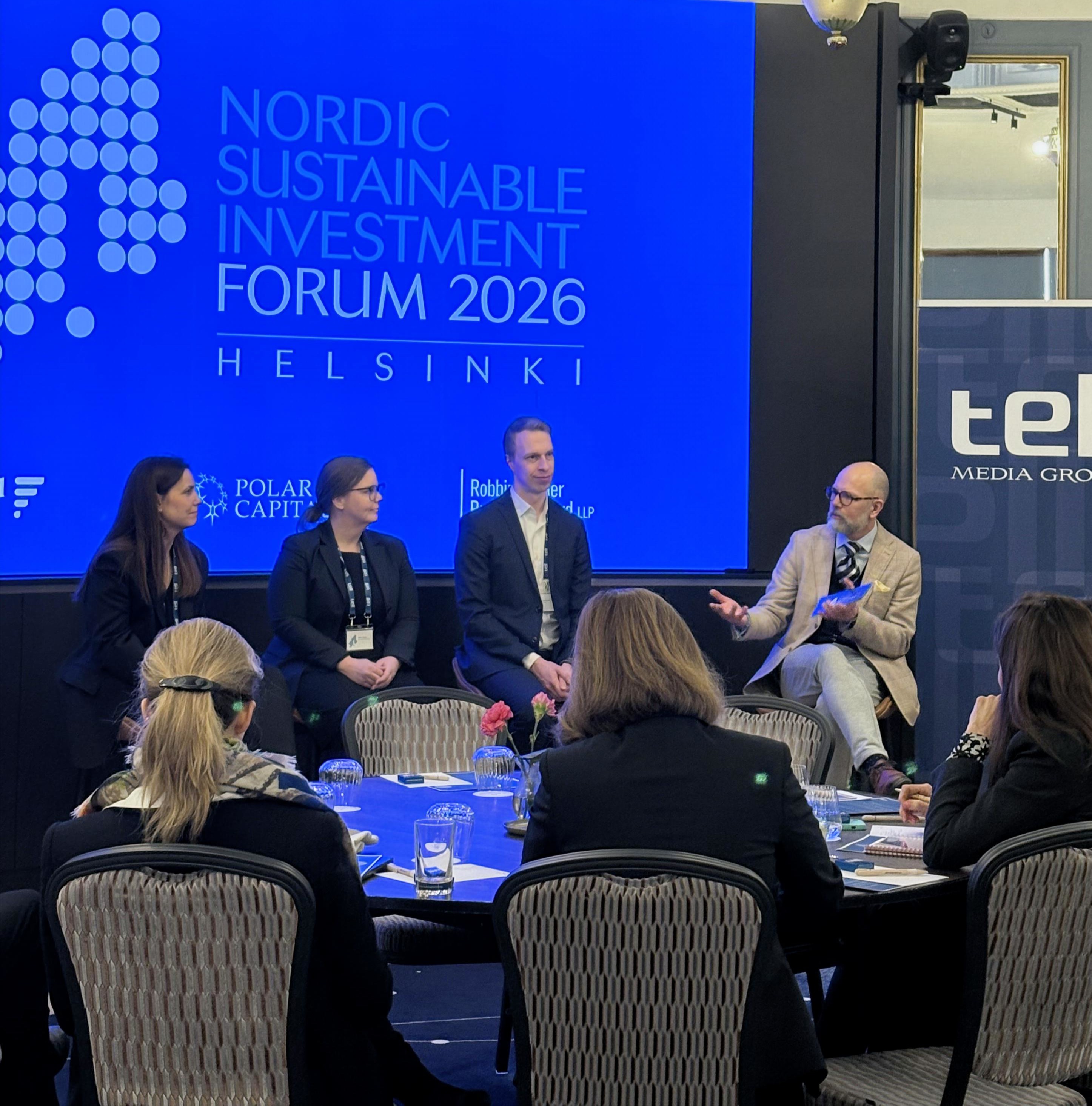
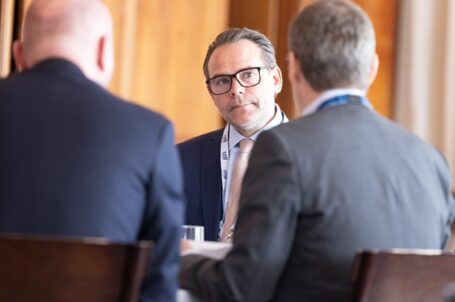
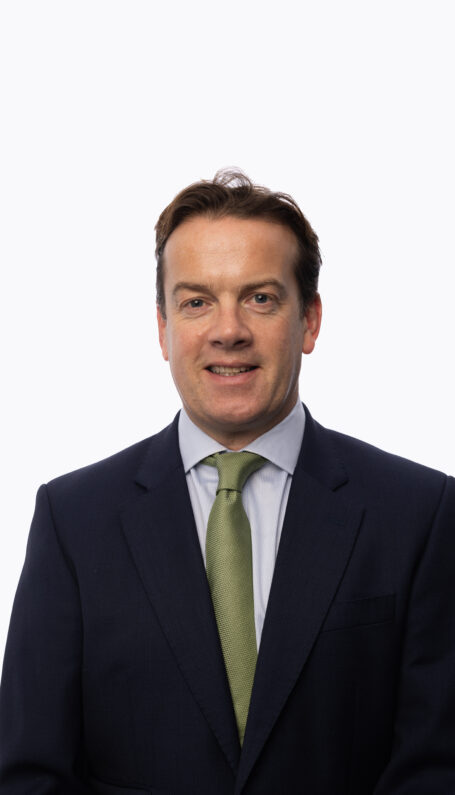
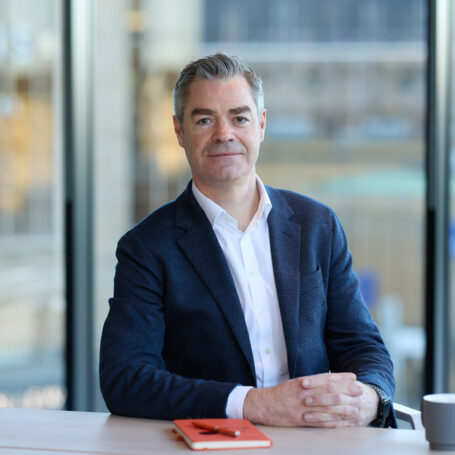
The panel discussion, which was held at the Nordic Sustainability Investment Forum in Helsinki at the end of February, started with a framing of corporate governance and what it means to be an active owner.
Niina Arkko: “For us at Aktia, active ownership is a very core tool to ensure sustainable and long-term value creation and it’s a combination of voting and engagements. Internationally we vote through proxy voting services and in Finland we attend the AGMs in person. In Finland we also have nomination committee seats, which is a very straightforward way of ensuring that companies have the right leaders and a way to influence the company’s leadership and their corporate governance. When it comes to engagements, we do these both directly as well as through collaboration. It’s also worth highlighting that engagement is not only about pushing companies in the right direction – it can also be a way to collect data you can’t get from ESG data providers.”
Rikke Jacobsen: “I think we’re quite similar in thinking that active ownership must be part of the desire to create long-term returns. But it’s also about accepting that the world is changing and that we need to support and challenge the companies even more and even better. We must be willing to say that if you do not meet our expectations we will vote against you. By connecting the investment decision to active ownership and engagement, we are also saying that when we don’t see progress, then there is an escalation procedure in place. That means we will either vote against the board, file shareholder resolutions or divest.”
In a recent discussion with a large institutional investor in Sweden, they said that they had come to realise that they need to better understand where they can truly have an impact and where it’s better to simply divest.
Rikke Jacobsen: “We are a relatively small asset owner and getting access to companies is increasingly difficult. That’s why collaborations are even more important, and we continue to focus on that. I also think that we need to become more creative in how we go about engaging with companies. One example is Amazon where we’ve been trying to engage for quite a lot of years – and I think most of you know that’s difficult. What we’ve done in this case is reaching out to partners of amazon to better understand and identify material risks. It’s about disrupting the traditional way, find new and alternative partners and data that support our objective. We need to disrupt the way we think about active ownership.”
Niina Arkko: “This is also a question about resources. We have a fairly small ESG team and even if the portfolio managers are also active in the engagement, we still need to choose which engagements and which topics and themes we can be involved in. We need to focus on the things that are most material.”
Valtteri Vulkko: “I agree that active ownership is getting harder in many aspects, but it still needs to happen. I also think that most people agree that engagement is the key mechanism to drive change versus just excluding dirty stocks and hoping that it will affect the cost of capital. As an impact data company, I think one opportunity is using new types of data and not only data that’s collected from the companies themselves. If we talk about climate risk, you can collect data and do risk modelling and show the company that this is actually financially material to you. That should have an effect.”
Rikke Jacobsen: “I agree. When we talk about the changing scene of active ownership, it’s all about being able to support that with facts and datapoints. Being able to approach a company and say that if you continue on the route that you have now, the consequences is that your assets will decrease in value is super important but also super difficult. If you want to challenge a big corporation on how to assess what is financial material, you need your research in order. That takes time, it takes resources and it takes data points. It’s also kind of a chicken and egg situation, because you need the data from the companies to do those assessments. We need to engage with companies in order to get realistic or good estimated numbers or reported data and then you can engage with companies against those data points. But if they’re pulling back, as we have seen a lot in the US and now also among European and Danish companies – then we’re stuck in a very difficult scenario.”
You talked about challenges to active ownership and engagement and that some markets – such as the US – are becoming more difficult. What’s happening and what are some of the key challenges?
Rikke Jacobsen: “What we’re seeing in the US since Trump took office, is a significant deterioration with companies pulling back from a lot of areas related to sustainability. We’ve also seen over the last couple of months actions taken by both the SEC and through executive orders that significantly reduce shareholder rights. One development came in November where the SEC changed its process, where the SEC significantly curtailed the no‑action letter process, meaning that companies no longer need SEC staff sign‑off before excluding most shareholder proposals from their proxy statements. It’s now up to company executives to decide which resolutions should appear on their proxy statements. In December an executive order [“Protecting American investors from foreign-owned and politically motivated proxy advisors”] advocating against the proxy advisor’s mandate and how they can advise on how investors should vote. All of this speaks to the structural changes we see in the US right now and we see that it’s spilling over to Europe as well.”
Niina Arkko: “I definitely agree. It will be more challenging, but there are still certain things we can do. We can still vote against the directors for example and – if a company is pulling back on all of their commitments, maybe then it’s for investors to decide if it’s a suitable company to be invested in? Litigation is also one of the tools in investors’ escalation toolbox, which is of course more common in the US than in Europe.”
We have talked about challenges and companies pulling back from reporting, which means alternative sources are data will become increasingly important. Valtteri – what are you seeing in this space?
Valtteri Vulkko: “I’m quite bullish on how the data landscape will be changing, not the least because of AI. If you look back, a lot of the focus was on what the companies report and what we can collect in a structured form and then deliver to investors. Today data is abundant and it’s not only quantitative data but also qualitative data. Today, satellite imaginary can be sustainability data. Factory location information is sustainability data this is data that can be collected at a fraction of what the cost used to be. Today, I would say that some of the most important data is to be found outside the company. If you’re interested in physical climate risks, you don’t need company reporting for that. You simply need to collect public information on factory locations and overlay that with flood risk areas for example. In short, I think we need to rely less on what companies are reporting. Not because companies would be lying, but because they don’t have endless capabilities or even incentives to produce this data.”
Rikke Jacobsen: “I fully support that – the outside-in perspective is really important as it will give us relevant data that can help us in our engagement and in explaining to a company why we consider a something to be financial material. This outside-in data is of course also critical in the investment decision – to ensure that we price the risks correctly. It’s also important because we’ve seen the data from some big ESG data providers deteriorate quite significantly. It’s therefore important that there are smaller data providers in the market that is not dependent on geopolitical pressure or political sentiment.”
Niina Arkko: “I fully agree and I’m also bullish on what we will be able to do with AI going forward. But I also think that we will likely still need external providers to help us to work with this in an efficient and structured manner.”
You have all mentioned the challenges with governments and companies pulling back from sustainability. Is there a risk that investors are also losing interest or focus more on other things?
Niina Arkko: “If I look at investors in Finland, I haven’t really heard about anyone really pulling back on ESG. I think everyone still think this is very material and relevant topic and risk that needs to be managed.”
Rikke Jacobsen: “I haven’t seen any asset owners in Denmark pulling back their commitments or their targets. It has however become an even broader topic. Defence and geopolitical are definitely taking up a huge part of our time today. So, it’s not about pulling back but rather recalibrating to the new world order that we are facing and acknowledging that responsibility is different today than it is a year or two ago.”
Are you also engaging with policymakers?
Rikke Jacobsen: “Ahead of the first iteration of SFDR last year we sent out a letter to all members of the commission. That resulted in responses from two countries – Sweden and Hungary – and we engaged with them and explained our expectations. We also met with the Danish Ministry of Business and while they listened to us we don’t see necessarily the direct line between that discussion and the work that has been done in the Commission. So, I think policy engagement is super difficult. I think we need to be better and here we probably also need to cooperate and speak as one voice rather than each asset owner doing its own thing.”
Niina Arkko: “At least during the last half a year I’ve been with Aktia, we haven’t done the direct engagement with policymakers, but we are active through the finance industry body in Finland. I agree – the power of collaboration is important here.”
Rikke Jacobsen: “I also think that we need to have realistic expectations and focus on what it is that we are supposed to do. We’re a pension company, not an NGO. We need to consider what is the right fit for our members as well and ensure that we are spending our time on work that matters to them as well.”
The panel discussion, which was held at the Nordic Sustainability Investment Forum in Helsinki at the end of February, started with a framing of corporate governance and what it means to be an active owner. Niina Arkko: “For us at Aktia, active ownership is a very core tool to ensure sustainable and long-term value creation and it’s a combination of voting and engagements. Internationally we vote through proxy voting services and in Finland we attend the AGMs in person. In Finland we also have nomination committee seats, which is a very straightforward way of ensuring that companies have the rightIf you’re new to Tell Media Group, create an account.
Read more about our memberships