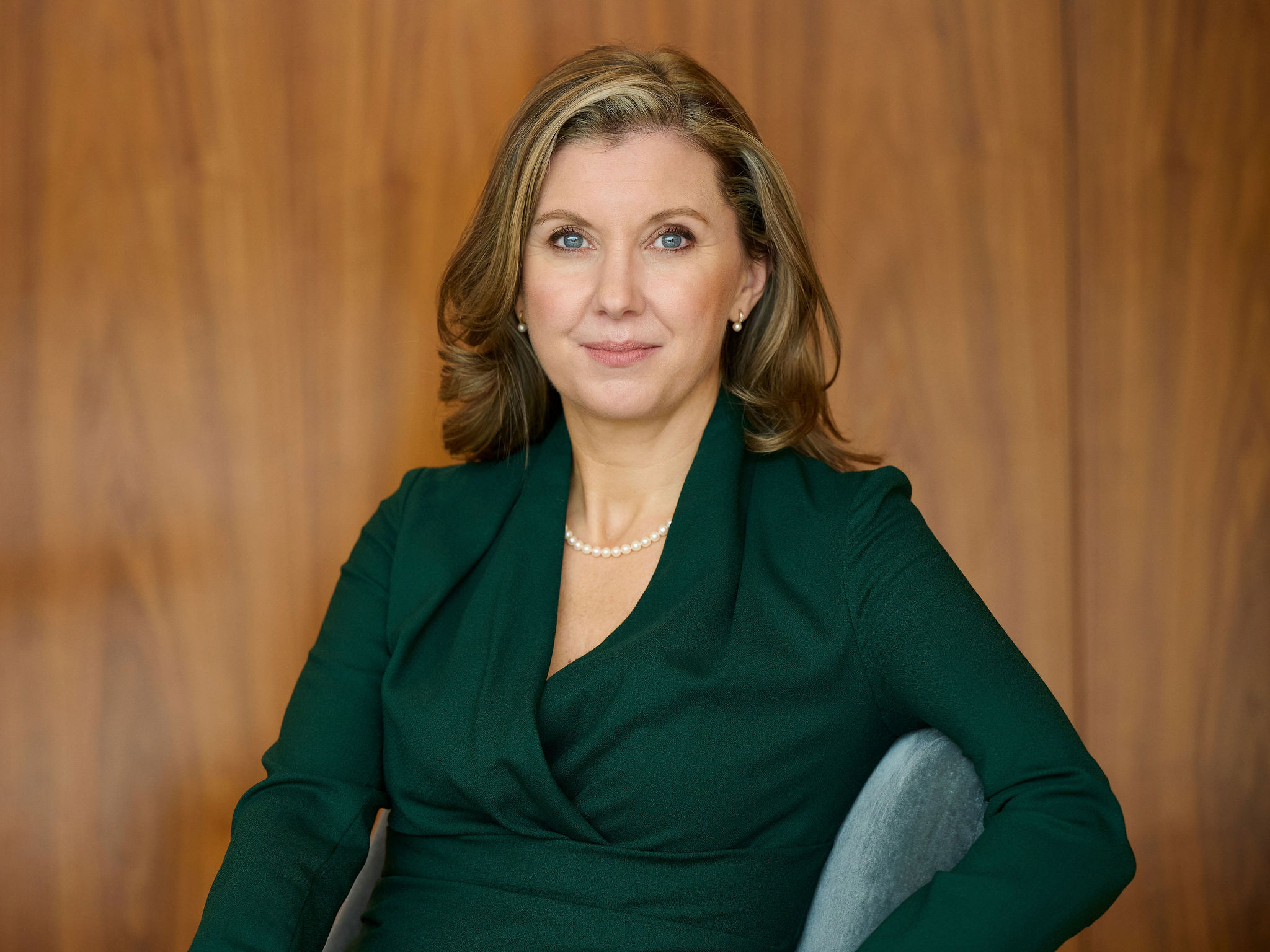
Looking beyond the immediate issue of the Strait of Hormuz, which Karen Ward hopes will be resolved by mid-summer, she says that she thinks that politics will continue to be a constant that will be top of mind for investors going forward.
“We’re going to have the midterms in the US, we’re going to have UK elections, we’re going to have French elections. So, this is something we’re just going to have to cope with as investors and I guess that’s one of the key points of my presentation. We’re going to have to almost become immune to this noise and be able to make long-term decisions because it’s not going away,” she says. She adds that a problem in Europe is that investors and savers aren’t acting in a way that’s immune to this noise.
“They’re absorbing all of it and therefore make bad financial decisions. But in terms of where I would say I’m kind of out of consensus is that I’m still really bullish on Europe as being the underpriced opportunity because I think that Europe is best in a crisis. I think we’re going to look back in the coming years and realize that actually the adversity from Putin and the different relationship with the US under President Trump has kind of galvanized the region together and forced us into a different, much more pro-growth policy regime. I think we’re going to be surprised by how Europe springs back to life,” she says and explains that she’s hearing conversations in Brussels that are so much more pro-growth and that there’s an urgency to that conversation that she finds really encouraging.
“But then I look at the equity market, which trades on 14 times or below across Europe versus 21 times in the US and I don’t think that is in the price. I think the perception is that Europe is structurally incapable of producing good corporate earnings and I just don’t think that’s correct,” she says.
She says that her big trade, looking through the noise, is to have a greater allocation to Europe. The other big thing that she’s thinking about beyond the short term is how to navigate the global tech story, which is a dominant theme in markets.
“Tech has become such a dominant part of not just the US, but global equity markets. How do you take advantage of the opportunities in tech, but at the same time navigate how exposed you are to the tech story if we go through any bouts of volatility. This is something investors really need to think about,” she says.
Asked if increased debt in Europe could be a potential problem and a hindrance to her big trade, Karen Ward highlights that the aggregate debt level in Europe is much lower than in the US.
“Germany’s prudence over the last 15 years means that Europe has learned the lessons of pushing debt markets too far. We have had our sovereign debt crisis, and we have implemented a lot of reforms to cope with that. Now, not every country in the region is in the same position. You could very reasonably argue that France has not yet had its full moment of reckoning and we certainly have not had ours in the UK, so I do not want to pretend the picture is entirely rosy. But, when I look across many of the major economies, I see a better starting point. Italy is running a primary surplus. Spain did a great deal to reform its public sector, and Germany has been extremely prudent for 15 years, which leaves it starting from a relatively low debt base. So, on aggregate, Europe looks far better in the debt stakes than many other parts of the world, including the US. That gives us some capacity now. When Germany announces that it is going to spend 12 per cent of GDP, the bond market responds: yes, sensible, good. If the UK tried to spend 12 per cent of GDP, the bond market would say: no, you are not. Germany is now getting rewarded for the tough decisions it made earlier on,” she explains.
Commenting on the general risk appetite, Karen Ward says that it comes back to fundamentals.
“We are writing our mid-year outlook at the moment, and while benchmarks have reached record highs in many parts of the world, it is not as if markets are unaffected by Iran. If you look at airlines, autos and consumer discretionary, those stocks have been hit quite hard. If you believe, as I do, that there must be some resolution to the Iranian situation, then those are the parts of the market with the most scope to catch up. I also think Europe could be part of that catch-up story. Yes, some parts of the market still look priced for perfection, but others are much more grounded in reality. It is really about focusing on the fundamentals. These are the kinds of moments when Warren Buffett’s line applies: be fearful when others are greedy, and greedy when others are fearful. We still have to get through this situation, and I do not think the end of the Iran issue will necessarily come with some big formal announcement about the Strait. I think we may simply wake up one day and see that ships are passing through again. But there is no incentive for the US to push itself into recession ahead of the midterms, and there is no incentive for Iran to push the global economy into recession either, because its allies, including China, would not welcome that. As long as you stay anchored in that view, there are still many parts of the market that I think can catch up,” she says.
Asked about the current spending among the so-called hyper-scalers and if there is a risk that they’re just throwing money on everything, Karen Ward says yes.
“I never like to say I don’t know, but to the question of whether tech is a bubble, you have to say: I don’t know. And the reason is that nobody knows. Bill Gates doesn’t know and Elon Musk doesn’t know and Sam Altman doesn’t know. The reason that none of us know is because we simply do not know what the end demand for these technologies is going to be. We don’t know whether it ends up being a consumer toy. I’ve made my dog talk using ChatGPT. It was hilariously fun, but I wouldn’t have paid to do that. I only did it because it was free. Or does this become a serious enterprise productivity-enhancing tool where the likes of JP Morgan and everyone else are going to pay big to deploy these technologies? We just don’t know. We’re all trying. Companies around the world are increasingly using these technologies, trying them, seeing what we can do with them, what we can’t do with them. We’re in that period of discovery. And it’s only when we know the answer to that question that we’ll know whether this investment was worth it. That, I think, is the problem with investing in global tech at the moment because tech is priced for it to be incredible forever. That it’s going to change the world. If you look at the valuations, it really does suggest that, although the valuations aren’t quite as high as they were, so there’s a little bit more caution. You can see the market is becoming much more discerning about this question of whether there is going to be a return on investment. The honest answer to the question is: we don’t know,” she says.
She adds that, as an investor, sometimes ‘I don’t know’ is enough of an answer.
“Do I want 35 per cent of my allocation of US equities in a theme where I don’t know a lot of the answers? Personally, no. I’d rather have a non-passive allocation to the US to take advantage of some of those other companies in the US that I do have a lot more conviction about in terms of what their earnings stream looks like. They might be really boring. It might be financials or things that aren’t as sexy and exciting as tech, but I just have a lot more certainty about what earnings stream I’m paying for,” she says.
She adds however that she thinks that AI will be productivity-enhancing, and she says that she thinks it will be meaningful. She says that it will probably not completely transform how she does her job and run her team, but incrementally, it absolutely helps.
“To me, the key point is that we still have a lot to learn about how it will affect business and consumer life. That calls for a degree of humility,” she says. Asked if increased use of AI will mean fewer junior analysts, Karen Ward says no.
“At the end of the day, if my junior analyst can suddenly do the job of three analysts, I want loads of them. I think we learned a lot during the pandemic. We were told the world had structurally changed, that we’re never going to go out again, we’re never going to interact, we’re going to sit in our little boxes and do everything via technology. I spent a fortune on a home office. What is obsolete? My home office. We’re human beings, we’re social creatures and I don’t think any of that ever changes,” she says.
Photo: Sarah Weal
Looking beyond the immediate issue of the Strait of Hormuz, which Karen Ward hopes will be resolved by mid-summer, she says that she thinks that politics will continue to be a constant that will be top of mind for investors going forward. “We’re going to have the midterms in the US, we’re going to have UK elections, we’re going to have French elections. So, this is something we’re just going to have to cope with as investors and I guess that’s one of the key points of my presentation. We’re going to have to almost become immune to this noiseIf you’re new to Tell Media Group, create an account.
Read more about our memberships