A big, untapped potential for private market exposure in the wealth segment. That was something that both SEB and EQT had observed – a conviction only grew during meetings and high-level strategic conversations between the two firms.
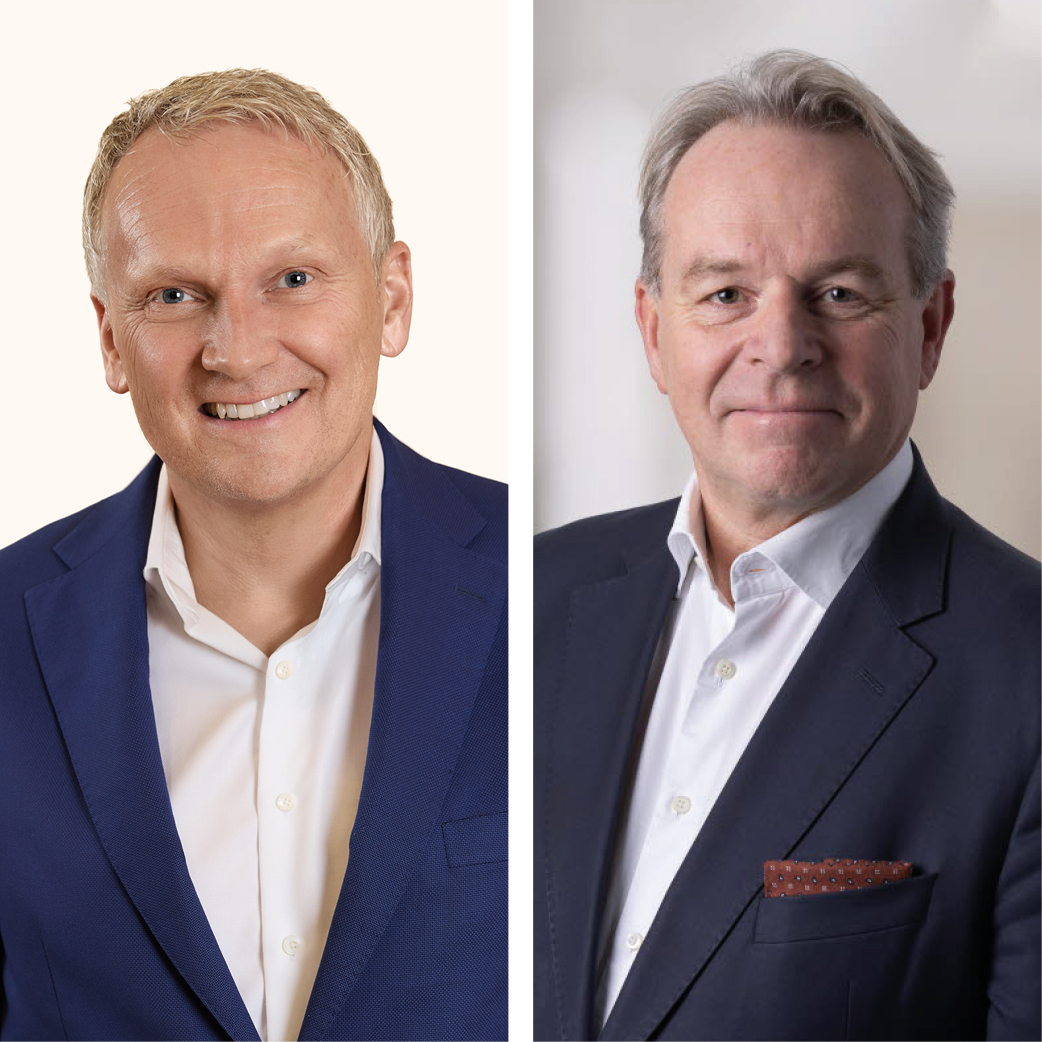
“The question was of course how to bridge that gap in the best way possible,” says William Paus, who has been with SEB for some 35 years and who is now head of wealth & asset management at the bank.
Peter Beske Nielsen, today head of global wealth solutions and evergreen strategies at EQT, says that the process started when he joined the firm at the end of 2020 after having spent more than 15 years at BlackRock.
“I joined EQT to establish the firm’s evergreen solutions platform to help enable access to private markets for individual investors, and I eventually found myself talking to SEB – originally about something else. When I met with William and his team it was obvious that we had a similar view on the future development for private markets,” he says and adds that they very soon concluded that this was an area where they should be working together.
William Paus agrees and says that it was obvious that there would be benefits from combining the knowledge from both firms.
“We’d seen the challenges and bottlenecks with the current way of distributing alternative exposures to a broader market. However, we also saw the demand and the benefits of being able to provide private market exposures and in our discussions with EQT we realised that we needed a different structure to meet the needs of our client base,” he says. He adds that the traditional formats with feeder fund structures were not very attractive with high operating risks and operating costs.
Peter Beske Nielsen adds that both firms realised that the opaque nature of allocating to private markets through draw down funds, which larger institutional investors have done for a long time, is a challenge for individual investors.
“It’s challenging, almost regardless of how wealthy they are, because it’s typically a ten-year structure. I think that’s the reason for both of us to go and address the challenge,” he says.
William Paus continues: “I think we established a common view from the beginning that combining our two perspectives could lead to quite a fruitful collaboration. That’s why we early in the process decided that we should do this as a co-creation”. He adds that this meant that they would really sit down, prototyping together rather than explaining what they wanted and then wait for EQT to come back with a suggestion.
“It was a very different approach from our side. I mean, it was probably the first deep co-creation type of structure that we had entered into,” he says.
Peter Beske Nielsen says that they looked around in the market of which structures would be suitable and that could work – both from an asset management and distribution point of view as well as from a liquidity point of view.
“We had some guidance from the market. The US is usually a bit ahead, so we looked at the US market and then we came up with this Luxembourg structure with monthly subscriptions and quarterly redemptions as a format that we could get comfortable with in the working group on both sides,” he says.
William Paus says that the key element was figuring out which structure would open the biggest possible potential market for the product.
“That’s the more technical side of things, such as the liquidity aspects. However, what’s also critical is educating potential investors to ensure they understand the exposure and how it should be used in a portfolio,” he says. He adds that it was a very open and fruitful process from the beginning and throughout the whole project.
“It was inspiring to sit down and to compare the EQT perspective and the SEB perspective and to figure out what’s possible and what’s not. It was also about getting the balance right to ensure it’s both a profitable product for us as well as an excellent product for the investor,” he says.
Peter Beske Nielsen says that the operational framework you need to have in place should not be underestimated.
“Before you go ahead with these products you of course need to understand the exposure and how the exposure behaves over time. But you also need robust fundamentals from an operational side. We spent a lot of time on the nuts and the bolts of the underlying operations,” he says.
William Paus agrees that this is one of the key elements to get right when making this type of product available to a wider audience because it’s complex.
“It’s complex so we needed to make sure that this is built into the process before we start the distribution process. We had experience from feeder structures and institutional distribution – but this required something else. That’s why we established a new project management to get this process right from the start. It’s resulted in a playbook that we use for other projects as well called ‘the winning concept’ – and it’s basically ensuring that you are running a lot of different work streams at the same time. One is responsible for reporting and the operational issues. Another is working on education and communication and then of course a plan for sales and distribution. You need to have an efficient process in place before you start onboarding clients. I think many banks struggle with that because it doesn’t really fit into the normal standard processes,” he says.
Considering all the moving pieces of the process, it still only took some six months from initiation of the project to the first trade being made around midsummer 2023. Peter Beske Nielsen says that it very much came down to what can be described as ‘the Nordic touch’.
“When we decided to do this, both sides opened up completely. Sometimes you run a process where each side feel that they need to protect themselves and maybe not ask the wrong question. We decided from the outset to be completely honest on both sides to understand 100 per cent of the nuts and bolts of the project. That’s what I call the Nordic touch. That’s what made the difference,” he says.
William Paus says that it took an offsite with his team to really get the process running as intended.
“When we started our discussion, I think both Peter and I shared a feeling that this would be a big opportunity. The initial feedback from the organisation was however a bit lukewarm. It is a new and complex product, and it could be complicated to convince clients about private markets. That’s when I took my management team for an offsite and the original agenda was replaced with one item – let’s work on the Nexus project. That’s when we decided on these parallel project streams and it was members of my management team who took charge of the different areas that we needed to focus on. That’s where we agreed that this is a huge opportunity and we got a shared mission – let’s be the first in the market to do this in this way. Then it happened quite quickly. I often use this as an example of how I want other projects to be run. It’s about sharing a big thought, a big potential and then making sure that you have very senior people who are responsible for different streams and just make it happen,” he says.
Peter Beske Nielsen adds that the success with Nexus was the reason for setting up the next evergreen structure, focused on infrastructure, in the same way.
“The project to set up Nexus private equity was so well organized that we did it again for infrastructure. We had the playbook ready,” he says. He adds that it was a benefit of launching in the Nordics thanks to the sophistication of investors in the region.
“I think we have seen very positive results from bringing the product from the Nordics to the rest of Europe, Asia Pacific, Canada and Latin America. The adoption has been significant, and everyone is talking about the evergreen evolution and how even institutions are allocating,” he says.
William Paus agrees and says that they have also seen interest from smaller institutions and family offices.
“We’re waiting for the cycle to be right for us to focusing even more on the institutional side of the market. I think there are a lot of benefits for family offices and smaller institutions to go into these types of structures instead of building a portfolio of 5, 10 or 15 direct engagements with managers,” he says. He adds that with investors already committed to these structures it will take time until they are ready to consider a different structure.
“I was quite convinced that the family office segment would be one of the more interesting ones for this type of structures, but it’s taken more time than expected. I still think it will be, but we need to move through this current cycle,” he says.
Peter Beske Nielsen adds that with more GPs launching these products, manager selection becomes increasingly important.
“The manager selection is very important because within alternatives the dispersion of outcomes is bigger compared to public markets. It’s also important to consider the operational framework, which we talked about,” he says.
William Paus says that they are fairly happy with the take up of the product, even if it’s been difficult markets in the last couple of years.
“I think the potential is bigger than what we have seen so far, but I think it’s very decent progress,” he says. Peter Beske Nielsen adds that there is always an adaptation curve for a new product.
“You always have some early participants, but as William said we’re still expecting family offices and institutional investors to engage over time. I’m convinced that we’re very early in the adaptation curve of this product. I think what SEB has done so far has been very strong and we will continue engaging with the institutional segment,” Peter Beske Nielsen says.
Asked about some of the most common questions they have received, William Paus highlights liquidity.
“We’ve been very careful about trying to make something liquid that is not very liquid. We’re open with clients that the liquidity of this type of structures is not the same as for a public market investment. If clients have a very specific need for liquidity, then it might be possible to get out some funds earlier. That’s how we believe investors should think about it,” he says. “It all comes back to education,” says Peter Beske Nielsen.
A big, untapped potential for private market exposure in the wealth segment. That was something that both SEB and EQT had observed – a conviction only grew during meetings and high-level strategic conversations between the two firms. “The question was of course how to bridge that gap in the best way possible,” says William Paus, who has been with SEB for some 35 years and who is now head of wealth & asset management at the bank. Peter Beske Nielsen, today head of global wealth solutions and evergreen strategies at EQT, says that the process started when he joined theIf you’re new to Tell Media Group, create an account.
Read more about our memberships