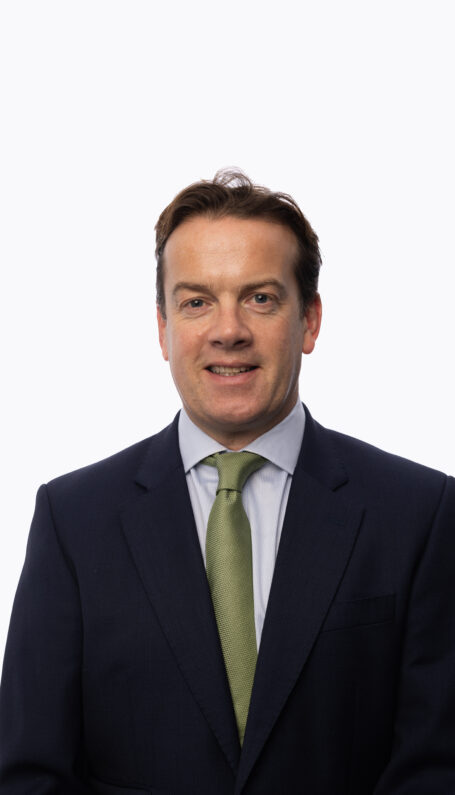
According to Andrew Harvie, a senior client portfolio manager at Columbia Threadneedle Investments, the strong equity market performance we’ve seen over the recent past is very much being backed by earnings growth.
“We’re seeing that in the earnings reporting period that we’re going through now. Companies overall are delivering good sets of numbers and importantly, it’s not just in AI exposed areas or in tech. We’re seeing it broadly across different industries and different regions,” he says.
“We’ve come out of a period where certainly last year you saw a rally, particularly in Europe, where there was a re-rating of names within certain segments and where earnings growth wasn’t coming through. You’ve also seen strong rallies, obviously, in everything AI exposed. There was a fear that sentiment was pushing things beyond fundamentals,” he says.
He continues: “We’ve had concentrated markets, and I think this broadening of earnings can only be a good thing. It means we have a bigger opportunity set. For us as active managers it means we need to be more active in recognizing the wider opportunity set and think about that when we’re building portfolios. It’s an exciting time to be a bottom-up investor today.”
Asked about how difficult it’s been to be an active manager during the period of concentrated markets and where the biggest companies in the benchmark were outperforming most other stocks, Andrew Harvie says that to answer that he needs to take a step back.
“We have a quality growth style of investing. We’re trying to find what we would call high-quality compounders, where we can benefit from that power of compounding over a multi-year period. For a good chunk of the last 15 years, as you say, some of that opportunity has been concentrated in a very narrow group of primarily US large cap growth stocks. It’s not been exclusive, but they’ve been some of the biggest drivers of earnings growth out there. We have had exposure to those, and we’ve benefited from their strength over that longer term period,” he says.
He adds, however, that they’ve not exclusively relied on the tech sector. Looking back at individual years, he says that it was their financials exposure that was the biggest contributor in 2017 and in 2018 and an important contributor also during the Covid pandemic. Commercial aviation was the biggest contribution in 2024 and the second biggest positive contributor last year.
“This is an indication that while we’ve benefitted from technology and while that’s been a big contributor to alpha over time, we’ve always been able to find opportunities outside of that space as well.” He adds that the team has always tried to have a degree of diversification to not be wholly reliant on one group of mega cap stocks that seems to dominate the market.
Asked about some of the questions he receives from investors related to their global equity allocation, Andrew Harvie says that it’s becoming increasingly interesting to be an active manager.
“We’ve of course had this push into passives and for a long period of time we didn’t see a huge spread in performance between different active managers with a similar style to our own. That’s starting to happen, which means investors are starting to take notice. They want to understand why some managers are doing well and why others are struggling,” he says.
He adds there is currently a narrative that quality as a style is not going to perform as well as it has when we’re in a world where there’s better economic growth, there’s inflation in the system and where rates have moved on from zero levels.
“This means that for the average quality manager, where the focus may be on healthcare, consumer staples and software and a handful of other things, the environment is much more challenging because the average that you need to beat is better. That’s why you’ve seen headlines like ‘quality investing RIP’ and I think it was The Economist that said something like ‘time to buy the most rubbish stocks you can find’,” he says.
He adds that this challenge might be true for the average quality focused managers, but that there are managers who have a bit of a twist in how they approach quality or how they think about their opportunity set.
“I think we’re one of these managers. We manage about USD 10 billion on the global focus strategy and we’re seeing a lot of people come to us because we screen at the top of the quality growth universe. They’ve seen how we’ve adapted and want to know more,” he says. He adds that there is also a growing number of investors who are thinking about adding more tracking error to their global equity allocations.
“If you think about pension funds historically, using a broad-brush kind of statement here, they generally wanted a more benchmark aware, lower tracking error kind of approach. And, if you can get that low tracking error exposure at a cheaper cost, then passive or enhanced index solution makes a lot of sense. I think, however, that we’re seeing more people saying that they want an active approach because they want something that can mitigate the challenge when the index goes down,” he says.
He adds that when they started the strategy 13 years ago, it was more of an intermediated wholesale-led client base. Increasingly the interest they’re seeing is from institutional investors who want it to sit alongside their lower cost passive solution.
Reflecting on what it means to be a quality growth investor today, Andrew Harvie argues that you need to view the market slightly differently.
“There’s been a lot of focus on keeping a low turnover and avoiding cyclical and capital-intensive businesses. We’ve always been very clear that economic sensitive and more capital-intensive industries are not necessarily a sign of a lack of quality. If we look back some 15 years, the narrative was you could find a great company and buy into it and hold it for a very long time. This world we’re in now with a broader earnings opportunity and with things like AI challenging some of the traditional business models, there is a need to be a bit more responsive. The idea that low turnover, low capital intensity, limited cyclicality equals good is something that needs to be re-framed. We’re active managers and to capture the opportunity set out there maybe we need to re-think these factors,” he says.
To conclude, Andrew Harvie says that even if they have decent resources in the global equities team with some 18 people in London, they couldn’t have the depth of coverage and industry knowledge around a broad range of sectors and geographies by simply doing it on their own.
“The reason we could have confidence to invest in Nvidia in late 2022 and continue adding through the share price rally that you saw in the subsequent year, is because we have a phenomenal, centralized semiconductor analyst who has been close to Nvidia for many years. The same applies to other sectors. That depth of insight and that depth of corporate access that we get as being part of Columbia Threadneedle is very important,” he says.
He adds that there is a structure to the collaboration in terms of how the team share ideas internally and with analysts across the firm and how those ideas are brought into the portfolio. That’s, however, not always how the best ideas are uncovered. “Some of the most valuable discussions just take place from picking up the phone or getting on a Teams call or grabbing a coffee together. It’s a healthy mix of ad-hoc and structured collaborations,” he says.