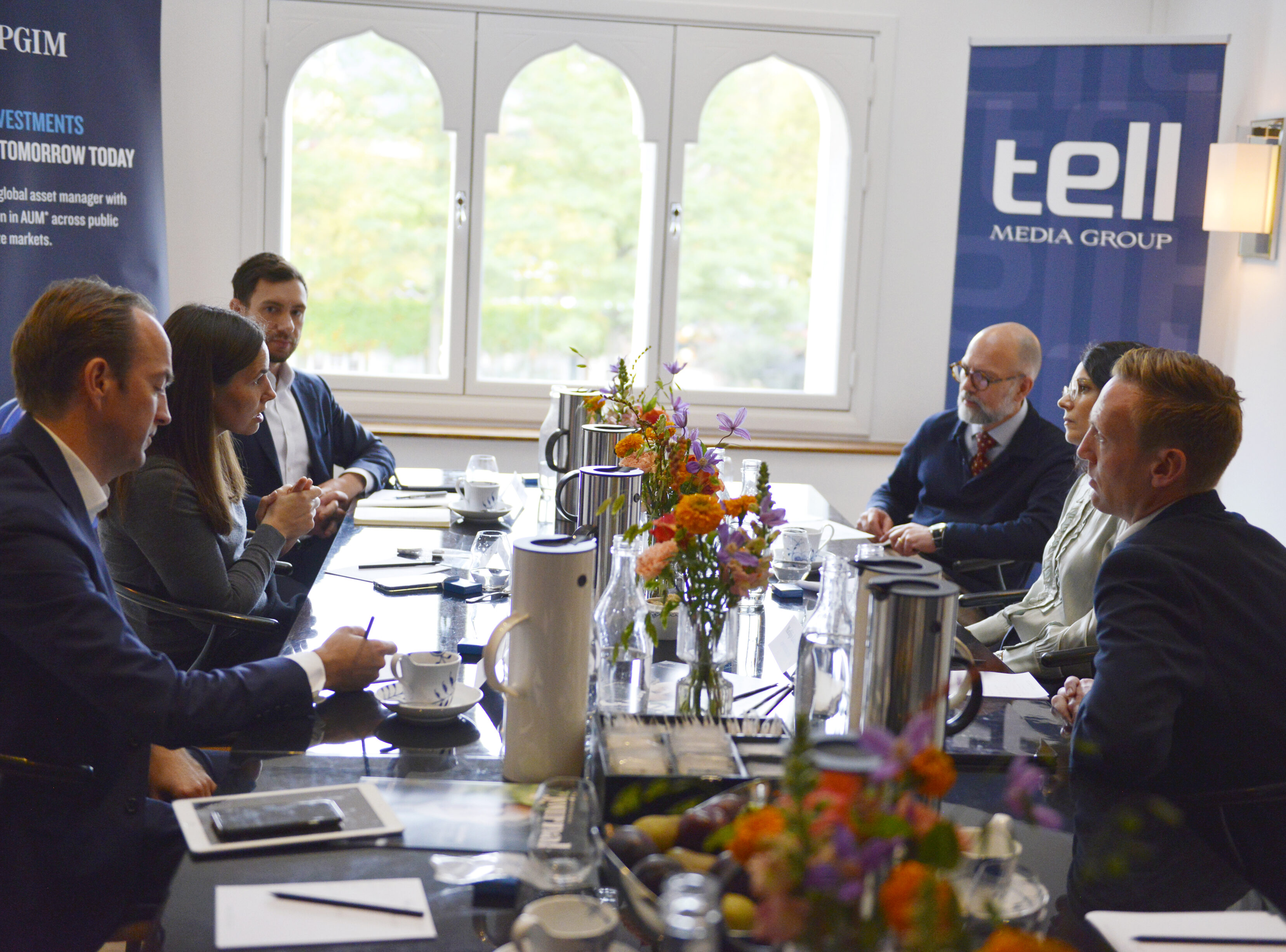
The discussion started with the asset owners at the table sharing their thoughts on how they approach sustainability issues related to fixed income and if that differs from how they approach other asset classes.
Rikke Berg Jacobsen: “I would say yes and no. The fundamental assessment of an individual company is broadly similar, while of course accounting for sectoral and geographical differences. The type of instrument can also influence how the ESG and sustainability assessment is applied. In fixed income, for example, you can invest through traditional bonds as well as use of proceed bonds or labelled bonds, where we also look at specific characteristics of each bond. That makes fixed income different from equities.”
Anna Maria Fibla Møller: “Our starting point for integrating sustainability considerations in our portfolio is the EU SFDR regulations and other international standards and frameworks. When we work to integrate ESG in the portfolio we try to tailor it to the specific asset class. High yield fixed income for example is very similar to equities, and it will go through the same process, whereas it will be another set of data when we assess an EMD mandate.”
Niklas Tell: Would you say that there are specific sustainability challenges to assess or work on when it comes to fixed income?
Mathijs Lindemulder: “We include ESG across the board regardless of asset class. It’s embedded in our process and it’s embedded in the DNA of our investment specialists. We invest across a wide array of fixed income and credit instruments – including instruments on the private side. One challenge specifically related to the private side can be data availability.”
James Malone: “Data availability can be a challenge within fixed income and specifically when it comes to privates and structured products. We have been focused on improving this picture which often requires deep research capabilities. We engage directly with management teams and conduct desktop research to build ESG assessment to address gaps in data coverage and have developed several tools and capabilities to ensure that our clients have access to critical data particularly around climate and emissions. Coming back to your question on what makes fixed income a little bit different, I’d like to echo what Rikke said. ESG factors can be material regardless of where you are invested in the capital structure – be it fixed income, equity or pirate credit. Ultimately the risks are the same, but the degree of financial materiality may be different.”
Rupert Cadbury: “I think data is crucial to sustainable investing. If you look at high yield that’s a universe with some 30 per cent private issuance. With less data coverage, how do you treat that part of the universe? Do you exclude until you have the data? You can’t ignore the data limitations and the impact that may have. Sovereigns is an entirely different area, and it needs different frameworks. It’s a part of the market that’s been lagging when it comes to data and standardization but there are now tools, frameworks and data sources that investors can use and consider. However, once you apply those frameworks and data, it can have an impact on your tracking error versus your policy benchmark so finding the right balance is crucial.”
Niklas Tell: What are you trying to achieve specifically on the fixed income side when it comes to sustainability?
Anna Maria Fibla Møller: “We assess the sustainability risks and opportunities across the portfolio. However, fixed income and EMD specifically is not an asset class that we have included in our target setting and CO2 reduction yet.”
Rikke Berg Jacobsen: “We have included fixed income in our target setting and we use the NZIF framework to assess the credibility of both the alignment curve and the targets. For corporates, we rely on TPI (Transition Pathway Initiative) and science-based targets. One of the key challenges relates to green bonds. It’s significantly more difficult to calculate or attribute emissions to a specific green bond, as there is currently no uniform methodology for assessing the emissions associated with those activities. There’s a PCAF (Partnership for Carbon Accounting Financials) consultation paper expected to be published, but I am not overly optimistic that it will provide a definitive solution.”
James Malone: “I think the issue around the accounting emissions on labelled bonds is quite an important one. It seems like the guidance from PCAF will allow investors to mark down the emissions that they’re assigning to labelled instruments, such as green bonds, without requiring a corresponding adjustment upward of the emissions across the rest of the issuer’s capital structure. The result is vanishing emissions which is very concerning. On NZIF, we’re really excited about the framework because it presents a standardized and credible way for investors to develop a forward-looking view on the climate impact of companies. Even if we’re unlikely to get full agreement amongst investors in respect to the classifications of individual issuers, NZIF is massive step in the right direction in our view. By adopting a forward-looking view, it enables company’s which are carbon intensive today and on the right path in respect to decarbonisation, to remain investable. Standard market practices tend to result in the divestment of well-aligned companies whose decarbonisation is critical to the success of the transition. This in turn, pushes up their cost of capital making the investments these companies need to decarbonise more expensive and may ultimately be having a counterproductive in terms of achieving real-world emissions reductions.”
Mathijs Lindemulder: “Another issue related to use of proceeds bonds and green bonds is that I see a growing divergence between issuers on their disclosures. If you look from a regulatory or regional perspective, you have the European green bond standard being implemented since the beginning of this year and we’ve seen some green bond being issued under that new regime. There are however differences in terms of what issuers can and can’t disclose on the other side of the pond. That’s a challenge for the market.”
Rupert Cadbury: “I think the labelled bonds is something we’re very fortunate to have in the fixed income space. Equity investors don’t have that luxury. A company that has high carbon emissions will typically be excluded or underweighted in portfolios that has a climate thematic objective. When an issuer issues green bonds, it provides investors a mechanism for transparency and accountability, enabling investors to identify and align their capital to companies committing to using the proceeds for specific environmentally beneficial projects.”
Mathijs Lindemulder: “One concern is the diversification of the green bond market and how it will evolve going forward. This market has been dominated by EU issuers and if you look at sectors, green bonds are still fairly dominated by utility companies and financial services. Asset owners and asset managers should be mindful of those kinds of characteristics.”
Anna Maria Fibla Møller: “It’s also a challenge to make the green bonds framework fit the SFDR framework. We have seen challenges in trying to document that some green bonds leave up to the good governance requirement of EU SFDR In this case the issuer is a bank and if you look at the MSCI data they don’t pass the good governance score, which is a challenge when considering to fit these investments for our investment product with focus on sustainability.”
Rikke Berg Jacobsen: “Another challenge we face is that if we have excluded a corporate, it also means that we cannot invest in a labelled bond issued by that same company. That makes it difficult to invest in and foster the transition. There’s also a broader challenge related to the fragmentation of regulatory frameworks across regions. For example, we don’t have an EU taxonomy equivalent for the US or for Asia. Most of the regulation is regional and we lack a global consensus; this creates complexity and inconsistency in how sustainability is assessed and implemented across markets.”
Mathijs Lindemulder: “I think we see some of that even within Europe. We do have the EU taxonomy, but there can still be differences between member states on what’s defined as acceptable activities. I think it will be very difficult to reach global consensus on what’s green and what’s not.”
Rikke Berg Jacobsen: “I think that’s why we shouldn’t rely only on regulators to solve this, but we need an asset manager and asset owner framework outlining what’s best practice for this area.”
Rupert Cadbury: “Many institutional investors have a global exposure to labelled bonds, which means they need a consistent standard and taxonomy to identify bonds aligned to the ICMA principles, such as that by the Climate Bonds Initiative. While it’s great that regulators establish some sort of standards, especially if that helps to improve transparency, for many investors they can’t rely on that as the single region-specific taxonomy to identify what is a credible green bond.”
Niklas Tell: Rikke, you mentioned the difficulty of financing the transition if you have excluded companies. What kind of discussions are you having around that?
Rikke Berg Jacobsen: “If a company is excluded, it is fully excluded meaning we also can’t invest in a labelled bond issued by that company. We have additionally decided to exclude the entire oil and gas sector that does not have ambitious exit and transition plan. We have a formal framework build on several factors, such as ambitious commitments and targets, a realties execution strategy and then we want to see actual reduction.”
Anna Maria Fibla Møller: “We’re currently not investing in labelled bonds from excluded companies, but this has been extensively discussed in the past. This is an area where I think it matters where you invest in the capital structure. If it’s listed equity, you’re investing in the whole company, but with a labelled bond it’s more like a project finance approach where you have ring-fenced assets and very clear use of proceeds.”
Niklas Tell: What do you typically hear from other investors?
Rupert Cadbury: “I think we see investors using labelled bonds as part of their toolbox. Some investors will allocate significantly to green bonds, whereas others are using other metrics to identify issuers who by the nature of their business activities align to the green transition.”
Mathijs Lindemulder: “We see different approaches. Some say that if it’s excluded it’s out, whereas others have specific interest to invest in the energy transition and want to steer their capital towards investment in the transition. The latter could be ok to invest in a green bond from a coal-related company.”
James Malone: “We work with a large and diverse group of clients to embed climate into their sustainability objectives. Green bonds and exclusions based on activity involvement such as thermal coal remain common tools. But increasingly we are working with clients that want to adopt capital allocation that takes a more holistic perspective in regard to supporting transition. While green bonds can be an important signal of credibility, from a transition perspective it’s also important to look at the issuer’s overall commitment, activities and track record.”
Niklas Tell: We usually consider equity holders as the owners who engage with companies and vote at AGMs. Do you engage and how do you engage from the fixed income side?
Rikke Berg Jacobsen: “We don’t have the same equity ownership position when we are engaging with a corporate, but in my experience, they are just as interested in talking with us and hearing our perspective from a fixed income standpoint. I don’t think the asset class is a limitation in itself – but we don’t have the same levers, such as voting at the AGM to influence the outcome. This means that our engagement strategy needs to be adapted to fixed income context.”
Niklas Tell: But I guess you can decide not to give them money.
James Malone: “Yes. As fixed income investors our most direct impact is through capital allocation decisions. Engagement and the influence we can have through our active ownership will always be important levers. But for investors that want to support more sustainable outcomes, capital allocation is an extremely important tool as it supports companies’ ability to invest in more sustainable products, services and operations. Cost of financing, especially in today’s environment can make or break sustainable project IRRs. So, I think in that sense, capital allocation by fixed income investors plays a consistent and really important role.”
Mathijs Lindemulder: “I would add a third pillar, which is ex-ante engagement, most specifically for private credit. Once you’ve entered or financed a loan, it becomes illiquid. On the listed side of fixed income, there’s a lot of data on controversial topics that you can screen issuers on and that’s great. But on the private side I think you can really add value as an asset manager in your fiduciary role before making an investment.”
Niklas Tell: Sustainability and ESG is more than climate and more recently we’ve seen defence becoming more topical here in the Nordics. Where do you stand on this topic, and do you currently invest?
Anna Maria Fibla Møller: “We have changed our policy, and it’s been a journey for us. It’s something that was a very explicit wish from our management to have more exposure to defence, so we had to find different options that could allow us to include defence investments within our current sustainability policy. It is important to remark that the changes relate to the tolerance level for defence manufacturers with some limited involvement in supplying components for nuclear weapons and that we still have hard exclusions on controversial weapons. It’s not been easy because you still have a lot of risks in the downstream value chain as it relates to who is using the weapons, which need to be highlighted and accepted. We’ve had some interactions with the board, with our investment committee and with our management and done a lot of risk analysis and we’re glad to see where we landed.”
Rikke Berg Jacobsen: “We’ve changed our policy as well. We continue to exclude controversial weapons, but we have opened up for conventional weapons and then we focus on the dual-use aspect of defence. I also believe it is important to clearly separate defence from ESG and responsible investing. I’m not comfortable saying that defence is a sustainable investment. For us, it’s a question of operating within our responsible investment policy and assessing how defence can fit into our standpoints.”
James Malone: “Looking back, I think it’s fair to say that the exclusions of the past linked to defence reflected people’s views at that time. But since Russia’s full-scale invasion of Ukraine, people’s perceptions and values around defence have changed dramatically. It therefore makes sense that asset owners are revisiting their exclusions to make sure that those exclusions align with the preferences and values of their beneficiaries. And within the context of rethinking approaches to defence, one very important consideration is the treatment of nuclear weapons. From a regulatory perspective in Europe, nuclear weapons are not considered to be ‘controversial weapons’. But if you exclude companies with involvement in nuclear weapons, it can result in between c. 80 – 90 per cent of the aerospace and defence being ineligible for investment as many of the largest companies have some small involvement on a relative basis, in the nuclear weapons value chain. Investors need be aware of the trade-offs that they’re making make sure they align with their beneficiaries’ expectations and preferences.”
Niklas Tell: Mathijs, would you agree that defence is not about sustainability, but rather about values?
Mathijs Lindemulder: “Yes, I would agree with that comment. I would also like to lift the discussion to include other things than listed instruments when we’re talking about defence. We’ve had discussions with investors and asset owners on other options to put money into the defence industry, such as public-private partnerships for example.”
Anna Maria Fibla Møller: ”There are certainly other instruments and structures, but in order to get exposure quickly we needed to look at listed equities. We really tried to find other types of vehicles, but those are also asset classes that take quite a lot of time and resources if you don’t have the experience.”
Rikke Berg Jacobsen: “Another challenge in this area is companies that are moving across sectors and how far down the value chain we should assess before we exclude companies?”
Niklas Tell: On a more general note – would you say that the ESG backlash that we’ve seen, especially in the US, could have a silver lining in that the industry has been forced to become more data driven and specific when it comes to sustainability?
Anna Maria Fibla Møller: “I think it is also very much driven by regulation requirements (EU SFDR). We have a pension product that’s classified as Article 8 and as soon as you have some degree of sustainable investments, you need to be very clear on which data you’re using, your processes, your documentation, and so on.”
Mathijs Lindemulder: “We are dealing with a wide array of clients across continental Europe and from my interactions and engagement with clients in the last couple of months, there’s still a strong momentum for continuing the journey that they started five years ago.”
Rupert Cadbury: “I would say that the key is providing choice, because different clients have different objectives – even when it comes to climate thematic approaches. I think it’s crucial to help shed light on the things which are complex or too difficult to understand and that may have prohibited investors from investing. We need to be a partner and be able to guide them to with what’s new in data availability, frameworks and standards – simply keeping them informed. Some investors focus only on financial return maximization, whereas others want to combine that with having a real-world impact.”
James Malone: “We also believe it is about offering clients choices and being a trusted partner to meet their respective investment and sustainability preferences. ESG risks and opportunities are factors that drive the fundamental value of investments and are firmly incorporated into our investment process across all of our mandates. But for clients that want to go beyond return maximization, it’s about having the capabilities to help them set and meet sustainability objectives, be it net zero investing, labelled bond allocations or SDGs integration, in a credible and intellectually honest way.”
Niklas Tell: What would you say are some of the areas where investors or managers should focus more on when it comes to this link between sustainability and fixed income?
Rupert Cadbury: “I think in order to help push the frontiers of sustainable investing a key part is improving the insights and the research that’s available. This year we’ve got the 10-year anniversary of the Paris Agreement, and we have COP30 in Brazil next month where biodiversity is going to be a key theme. Investors are increasingly asking how to incorporate biodiversity into their investment strategies, so we are of course working to assess the data availability and helping investors to identify the risks as well as the opportunities.”
Mathijs Lindemulder: “As I mentioned before, we see a lot of momentum in alternative credit and that requires a different way of thinking and a different way of embedding sustainability. I think there’s a huge opportunity for asset owners and asset managers to rethink how we embed sustainability in for example structured credit and other private credit type of asset classes.”
Rikke Berg Jacobsen: “Knowing the companies that you buy is always key and will be so going forward as well, especially in private credit. If you do this in-house it puts a lot more responsibility on asset owners to have the competence and the capabilities to cover those aspects.”
Mathijs Lindemulder: “I would of course advocate working with a specialized manager for that because it does require a lot of resources and knowledge and it’s different from traditional liquid large cap investing.”
Rikke Berg Jacobsen: “It’s also a different time horizon. When you’re in it, you’re in it and then you need to assess the longer term. So maybe based on where we are today, we would invest, but will we be ready to stand up for the investment down the line?”
Niklas Tell: Where do investors want to go next when it comes to sustainability and fixed income?
James Malone: “There is an increased appetite to take risk not from an investment point of view, but from a reputational standpoint by supporting high carbon emissions companies in transition. The world is unfortunately extremely off track to meet the Paris Agreement goals and there is growing recognition that existing approaches to climate investing are not working as intended. We need to prioritize real-world emission reductions and that means trying to focus on the transition of the companies that are really material and are taking credible action to decarbonise.”
Rupert Cadbury: “I agree that there’s a lot to be done on the private side, but what should investors do with their core exposure? We’ve been working on a concept we call sustainable outcome investing, which sits in the space between sustainable investing and impact investing. How do you align your core exposure with real world sustainable outcome? With the help of data, you can actually find companies within the broader index that by the nature of their business activities are intentionally doing activities which have positive real-world outcomes. That means looking at the intentionality and their degree of contribution and measuring that over time.”
Niklas Tell: What are some of the things that makes you optimistic on the development and what are some of the things that could be problematic when we are talking about the intersection of sustainability and fixed income?
James Malone: “There’s unfortunately quite a lot to be negative about in respect to the direction of travel for many environmental and social regulations around the world. But there are also a couple of bright spots. I think that the EU’s emission trading scheme and the carbon border adjustment mechanism, which enters into its definitive phase next year, is one of the really interesting positive developments and should increasingly give more carbon efficient companies the opportunity to outperform.”
Rikke Berg Jacobsen: “My biggest concern relates to companies starting to pull back their commitments and targets. If they stop reporting, we will see a reduced transparency and the data coverage and quality will suffer. We continue to engage with companies on this to ensure that they continue to report, even if they are forced to forego their targets for political reasons.”
Anna Maria Fibla Møller: “One trend that could be both positive and negative is the current geopolitical uncertainty. This is steering attention away from climate discussions as everyone focus on energy security and defence. However, the end result might still be a reduction in CO2 emissions while at the same time we secure energy in Europe. When it comes down to regulations, I think we need to continue focusing on what we have been trying to achieve with the whole EU regulation: to direct capital to green activities and to support sustainable investments. Right now, the result of the regulation is more administration and less actual investment in green and transitioning activities.”
Mathijs Lindemulder: “I think it’s positive that we have reached some sort of consensus on measuring carbon footprints and there’s growing consensus on how you could measure the biodiversity impact of your portfolio, either on the positive side or on the negative side. I also see an increase in impact investing, at least in Northwestern Europe, so having a positive and measurable impact with your investments.”
Rupert Cadbury: “In my mind, the biggest concern relates to reduced transparency, as indicated by Rikke, because that’s critical for our stewardship and engagement with companies. I think in terms of opportunities, biodiversity is a key theme with improved data disclosure and reporting. We’re also seeing improvements in the impact reporting of labelled bonds, which is very positive.”James Malone: “I agree that there is a need for increased focus on biodiversity from asset managers and investors. The challenge however is that a lot of the biodiversity risks are concentrated in sectors that are not directly investable by the market and that the biodiversity risks that are influencing companies are often indirect, systematic and very long term in nature. We therefore need to be a little bit careful and not overpromise what we can do in respect to biodiversity as asset managers. As an industry we need to take some of the lessons that we’ve learned from climate and make sure that we’re not over-promising or creating products promote biodiversity as an ‘investable’ theme. It’s difficult to find many pure-play companies that are definitively positively influencing biodiversity in a material way especially in the context of the company’s overall business. But that doesn’t mean we shouldn’t and can do more. Watch this space!”
Participants
Mathijs Lindemulder, head of responsible investment and corporate strategy continental Europe at Aegon Asset Management
James Malone, vice president and ESG specialist at PGIM
Rupert Cadbury, sustainable investing strategist at State Street Investment Management
Anna Maria Fibla Møller, head of responsible investments at AP Pension
Rikke Berg Jacobsen, head of ESG at AkademikerPension