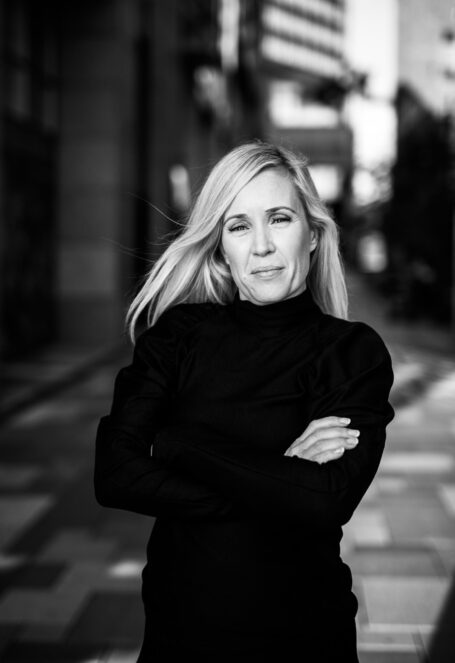
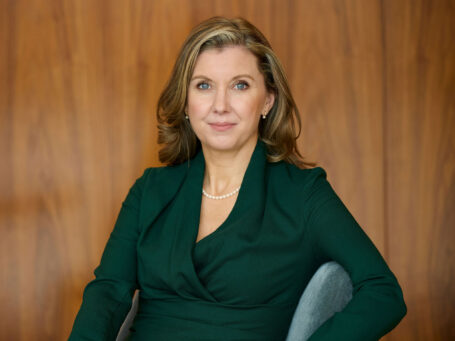
“As a manager selector you meet a lot of intelligent people and you have a finger on the pulse of the industry. You know what’s happening and I think it’s a profession that we need to embrace even more than we do today,” Karolina Qvarnström says as she reflects on her experiences from manager selection.
Lately she has, however, worked more on product development and the insourcing strategy as Länsförsäkringar moved a majority of assets in-house. A lot of her time was spent on project management and building the middle office in the fund company. “During my time at Länsförsäkringar, we moved from 100 per cent of assets being white label to having some 10 per cent of assets outsourced,” she says.
Today, it is only European equities, global equities, US equities, emerging markets and Asia that are outsourced. Karolina Qvarnström notes that some of the obvious benefits are cost and control. On the other hand, she says that what you risk losing when you’re not working with external managers can be scale and you also don’t have the same independent monitoring.
“As a manager selector, the task is to be objective and independent in order to make the analysis as fair as possible. When working with many different asset managers, you gain a broad perspective as well as deep insight that is valuable in evaluating all of them. Imagine if one could use that expertise and experience in evaluating internal asset managers as well. This could be achieved by creating a culture of trust and where people work together to create value for the shareholders. However, this is not an easy task as it involves evaluating your own colleagues. Instead, this responsibility is in many cases, naturally, left to the head of asset management. I would love to see more professionals within manager selection,” she says.
She says that working on the internal strategy and building that team was very rewarding but adds that she missed the interaction with external parties. “I missed what I did when I worked as a manager selector. It’s very rewarding to meet people that are smarter than you and as I mentioned before, you keep a finger on the pulse of what’s happening in the world. It’s simply inspiring and fun to be a manager selector,” she says.
When asked what she thinks is required to excel in manager selection, the answer comes quickly – integrity. “You also need a clear evaluation model. Manager selection is very much about relationships and in order not to ‘fall in love’ with a manager or strategy, you need both integrity and also a model that you can hold on to,” Karolina Qvarnström says.
She adds that the work is very much about transforming soft facts and something that is very subjective into hard numbers. “The numbers themselves are easy and you can use that for your quantitative analysis but then you need to understand why the numbers are what they are,” she says. She also says that it is important not to take decisions on your own because then you can start to move away from the process to make it fit something you really like.
“You need a committee or a colleague that you can argue with. You should be forced to make arguments for what you think. I had very heated discussion with the colleague I had in the manager selection team and that was very helpful,” she says. But even when that support system is in place, Karolina Qvarnström says that it is still important to trust your gut feeling. “If something feels off, then it’s probably something that you have missed in your research. Then you should look again or walk away,” she says.
When asked about the development relating to sustainability, Karolina Qvarnström notes that there have been huge developments and adds that Länsförsäkringar was early to ask its external managers to consider sustainability aspects in the management of the funds. “We did a big work to influence managers in the early days. Today it’s a non-issue most of the time,” she says.
Nevertheless, she emphasises that communication related to sustainability is very important because what sustainability means can be different for different clients. “It also depends on the time horizon,” she says, considering that some companies are sustainable today while others are transitioning and will become sustainable tomorrow.
Karolina Qvarnström further notes that while the aim with manager selection is to find the best managers, most likely they will not all follow the same investment philosophy and they will not all follow the same sustainability framework. “I think that’s a strength and I therefore don’t think we should limit them by strictly enforcing a house view on them. You of course need to take the overall exclusion list into consideration and other minimum requirements but I do think we need to be comfortable and embrace smaller differences and be better at communicating our stance,” she says.
KAROLINA QVARNSTRÖM ON…
… INDUSTRY CHALLENGES IN SWEDEN
“One thing that has had a big impact on the industry is the procurement of new funds to the premium pension system that’s currently underway at the Swedish Fund Selection Agency. It puts pressure on Swedish fund companies because I think most are not used to compete for mandates in this way and many don’t have big RFP teams like the international fund companies. The process will also redistribute assets and we already see the impact [in the form of] mergers among Swedish fund companies. I also think it will have an indirect effect on manager selection as the funds selected for the premium pension platform will become the default list of ‘good’ funds.”
… TRENDS IN PRODUCT DEVELOPMENT
“I’ve noticed that products used to be more complex. It seemed as if it was a trend that product should be difficult to understand. It was cool to have complex products. The problem was that investors and clients didn’t really understand. Funds have become simpler and more straightforward. It’s easier to understand what they’re meant to deliver. I’m not saying it’s wrong with complex products but it becomes harder to measure risks and it absolutely becomes harder to communicate with clients.”
In early October, Karolina Qvarnström announced that she was leaving Länsförsäkringar after some 17 years at the Swedish pension and insurance company. She started out as an investment manager for alternative investments, investing in private equity funds, infrastructure and real estate funds for Länsförsäkringar Liv, before moving on to the role as manager selector at its fund company arm in 2010. She was responsible for manager selection and product development for Länsförsäkringar’s international equity funds until 2021 and even though she has spent the past few years in other roles, it is clear that fund and manager selection is still close to her heart.
“As a manager selector you meet a lot of intelligent people and you have a finger on the pulse of the industry. You know what’s happening and I think it’s a profession that we need to embrace even more than we do today,” Karolina Qvarnström says as she reflects on her experiences from manager selection. Lately she has, however, worked more on product development and the insourcing strategy as Länsförsäkringar moved a majority of assets in-house. A lot of her time was spent on project management and building the middle office in the fund company. “During my time at Länsförsäkringar,If you’re new to Tell Media Group, create an account.
Read more about our memberships