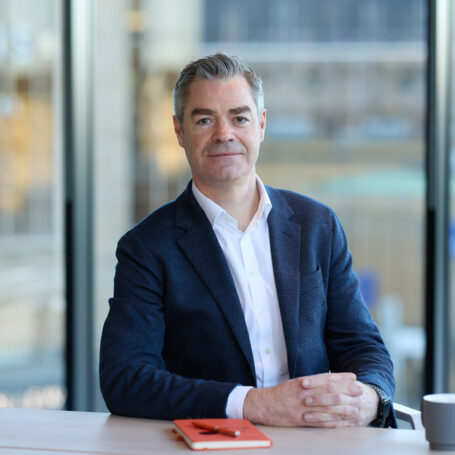
According to James Cook, investment director, emerging market equities at Federated Hermes, their Asia Fund is a very differentiated offering with a contrarian bottom-up focus that seek the most attractive price to value opportunities.
“It has resulted in a portfolio that historically has more of a value bias because of where we’ve seen the opportunity. It’s also a portfolio that’s very differentiated to a lot of our peers and one that has delivered market leading returns. We’re top quartile over one year, three-years, five-years, ten years and since inception,” he says.
The team, led by Jonathan Pines, has been in place since the very beginning back in 2010 when the strategy was launched. They currently run some USD 8 billion in the strategy, of which USD 6.4 billion sits in the UCIT fund.
“For us, the biggest risk is losing money. We are contrarian, we’re investing in companies that we assess have suffered some near-term mispricing. It may be an earnings miss, or we’re at the bottom of the earnings cycle, or they’ve changed their product mix, or come to the end of a period of capex. Whatever has resulted in the mispricing to intrinsic value, we assess to be temporary. Where there’s negative news flow, you tend to get valuation gaps and mispricing opportunities and at times that can be in whole markets,” he says and adds that they will often be in markets that are most hated or unloved by other investors.
“That’s where the pricing opportunity is strongest. With our contrarian style we also find that our portfolio is very complementary to what investors may already have in the region,” he says. He adds that he’s amazed by how Asia ex Japan continues to be very under owned, underappreciated and underpriced.
“It offers a rare combination of structural growth, diversification and valuation support, yet it continues to trade at a meaningful discount to developed markets despite stronger long-term earnings potential. For a long time, investors haven’t had to think further than the MAG 8 and the very narrow leadership of US equity markets, which have delivered 20% plus returns for nearly a decade. Slowly that has changed and doubts around US exceptionalism and Trump in the White House. Many investors I talk to are looking to diversify that exposure from the US and they are looking to Europe and in a large part to Asia,” he says.
He adds that Asia is home to a lot of globally competitive companies that are exposed to some of the most important structural trends at this moment such as semiconductors, the AI infrastructure, agentic AI and even physical AI in the form of humanoids and robotics.
“One of my favourite things is looking at the Spring Festival in China where they run a half marathon in Beijing. Last year they ran humanoid robots, some fully autonomous and some controlled by humans, and some failed pretty dramatically, and others were more than capable of running the course. I think the winning robot last year did it in about two hours and 10 minutes. This year the winning fully autonomous robot did it in 54 minutes. That’s an indication of the development in this space,” he says.
He adds that Asia is also leading the way when it comes to electrification, electric vehicles, battery and energy storage – which is becoming increasingly important when considering the energy transition.
Asked about how their contrarian and value focus is expressed, James Cook says that what makes them different is their focus on taking a bottom-up perspective on where the most attractive price to value opportunities are
“I like to use a car analogy as a proxy for quality – so we’re looking to buy a Ferrari at USD 100 000. That’s a great price to pay for a Ferrari and we would have a portfolio full of Ferraris if we could find them at that price. But often, Ferraris trade at USD 200 000 or even a million dollars. Now, we’re not going to pay USD 200 000 for a Ferrari. We’ll be happier owning a well-engineered but lower quality Ford at USD 10 000. What makes us different is that we’re going up and down that quality spectrum depending on where we see the most attractive price to value opportunities. Most of our peers are only looking for high quality growth. That limits their universe of opportunities but also lays them open to the mistake that they overpay for the quality of growth that they’re getting,” he explains.
He adds that they are of course aware of the AI thematic, but that they try to find what he calls discounted or defensible technology.
“Not all tech boats deserve to be lifted in the way that they have done. We’re currently about 12 per cent underweight technology at a benchmark level. We have 25 per cent of the fund in technology, so a quarter of our fund is exposed, but it’s in what we would call defensible or discounted tech. In Korea, we’re invested in Samsung that we view as the most discounted of the memory names and it’s illustrative of the positive asymmetric risk return that we look for in our biggest positions in the fund. We of course invest in companies that we expect will deliver a decent return – but we also want to limit the downside if we’re wrong and being contrarian investors, we do expect to be wrong. Last year Samsung was trading below book value because it had fallen behind competitors Hynix and Micron in the AI related memory space that has driven super earnings for Micron and Hynix. At 0.9 times book, we saw very limited downside for a global player, not just in memory, but in smartphones, in display, in electronics, in cloud and also in foundry, where they compete with TSMC. We fully expected that they would catch up and make progress on the high bandwidth memory and therefore participate in the super earnings of what some are calling this super earnings cycle. And I think that is illustrative of the sort of asymmetric risk return that we focus on,” he says.
He adds that as this is a volatile asset class, it’s important to focus on the downside protection.
“It is great that returns are drawing investor attention, but that hasn’t always been the case, and it hasn’t always been up. In our 16 years of running money, we’ve had five years of negative returns at a benchmark level and in every one of those years, we’ve delivered a better outcome and that’s important,” he says and adds that they are patient contrarians.
“We don’t mind being early, and we often are. That’s why we make sure companies can survive what may be a challenging environment by having solid balance sheets, decent cash flow, often excess cash and an ability to return that to us as shareholders,” he says and adds that being contrarian means that you need to be prepared to be uncomfortable.
“You need to be prepared to be wrong, to be in the areas that others aren’t and to be patient. However, to take advantage of those mispriced opportunities where news flow is negative is precisely what provides that opportunity where there is a big dispersion between price and intrinsic value or the fundamentals. That’s what we really seek to do – to buy things when they’re cheap and sell them when they get a little bit more expensive,” he says.
He explains that with Korea being the best market in Asia, they’ve been trimming into that strength and been very disciplined. “While Korea has become fashionable, we’ve gone the other way and we’ve been cutting our overweight from 20 per cent when no one was in Korea. We’re still overweight because we see compelling opportunity, but significantly less. Today, when tech is drawing everyone’s focus on a very narrow, massive momentum market, we see plenty of opportunity in overlooked China,” he says.